
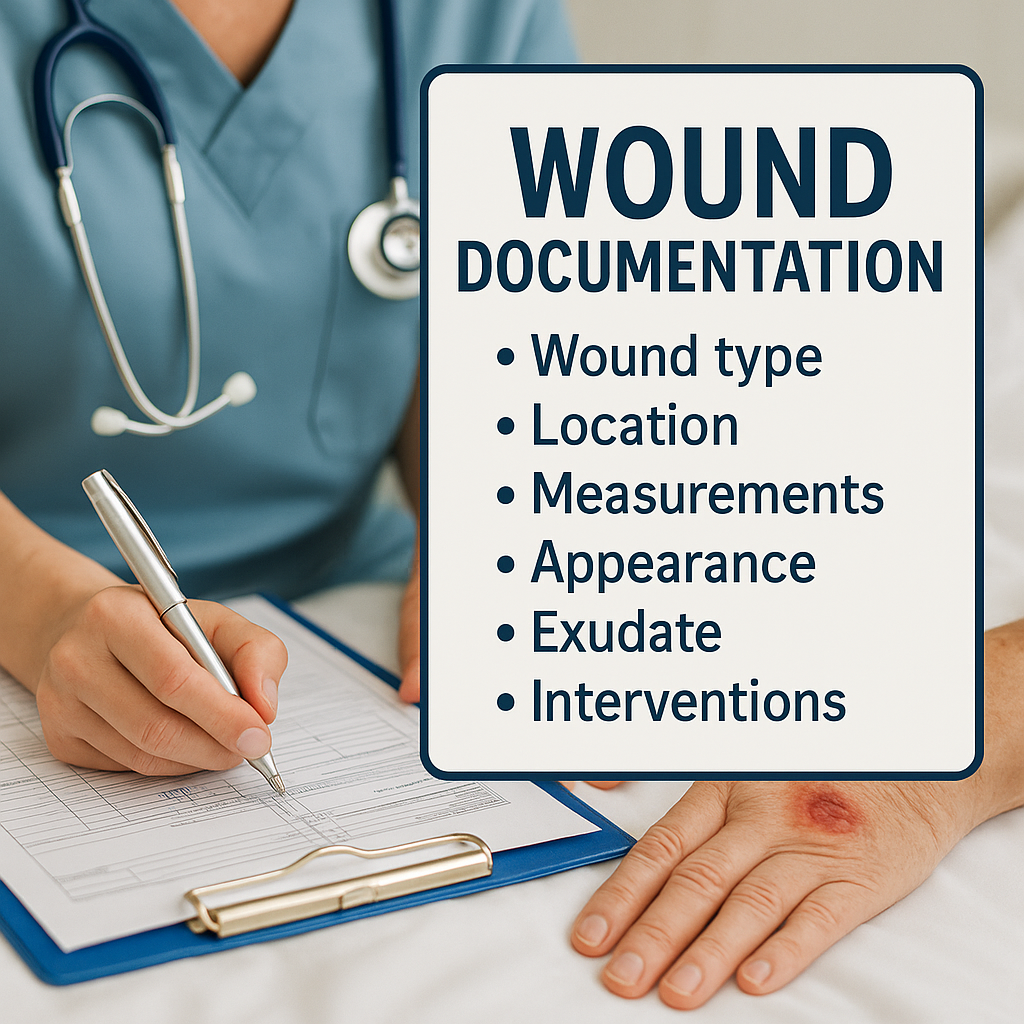
Wound documentation is a routine part of nursing care, but it requires accuracy, consistency, and attention to detail. Clear documentation allows healthcare teams to monitor wound progression, evaluate treatment effectiveness, and communicate patient status across shifts and disciplines. It also serves as a legal record of nursing assessment and intervention.
This article focuses on nursing wound documentation examples used in nursing education and clinical practice. It explains what should be documented, how wounds should be described, and how documentation is typically structured in healthcare settings. The goal is to provide practical guidance that nurses and nursing students can apply during clinical assessments and charting.
Wound documentation in Nursing Practice
Wound documentation is the process of recording observable wound characteristics, nursing interventions, and patient response. Documentation should be factual, objective, and based on direct assessment findings rather than assumptions or interpretations.
Accurate wound documentation is used to:
- Monitor healing or deterioration over time
- Support treatment planning and provider decisions
- Communicate wound status to other healthcare professionals
- Meet institutional, regulatory, and legal requirements
Wound documentation is commonly completed in:
- Electronic medical records (EMRs)
- Wound assessment flowsheets
- Narrative nursing notes
- Home health and long-term care documentation systems
Well-documented wound notes allow any clinician reviewing the chart to understand the wound’s condition without seeing it in person.
wound documentation cheat sheet
A complete wound note follows a structured format. Each component provides specific information that contributes to accurate clinical decision-making.
1. Wound Identification
Begin documentation by identifying the wound type and, when known, the cause. This provides clinical context and helps guide appropriate care.
Common wound types include:
- Pressure injuries
- Surgical incisions
- Diabetic ulcers
- Traumatic wounds
- Skin tears
- Burns
Example:
Stage 2 pressure injury to sacral area
2. Wound Location
The wound location should be documented using precise anatomical terminology. Specific location details are especially important when multiple wounds are present.
Examples:
- Right lateral heel
- Midline lower abdomen
- Left plantar forefoot
Avoid general descriptions such as “leg wound” or “foot ulcer.”
3. Wound Measurements
Measurements provide objective data used to track wound progression. Measurements should be taken consistently using the same technique each time.
Document:
- Length × width × depth (cm)
- Tunneling or undermining, if present, using the clock-face method
Example:
2.5 cm × 1.8 cm × 0.4 cm depth; undermining 0.8 cm at 3 o’clock
4. Wound Bed Description
The wound bed should be described based on visible tissue only. Avoid assumptions about infection or healing unless supported by objective findings.
Common descriptors include:
- Granulation tissue
- Slough
- Eschar
- Necrotic tissue
Percentages may be used to show tissue distribution.
Example:
Wound bed consists of approximately 70% red granulation tissue and 30% yellow slough.
5. Exudate
Exudate characteristics help assess moisture balance and possible complications.
Document:
- Type (serous, sanguineous, serosanguineous, purulent)
- Amount (scant, small, moderate, large)
- Odor (present or absent)
Example:
Moderate serous drainage noted; no odor present.
6. Peri-Wound Skin
The skin surrounding the wound should always be assessed and documented.
Common findings include:
- Intact skin
- Maceration
- Erythema
- Warmth
- Induration
Example:
Peri-wound skin intact with mild erythema.
7. Pain Assessment
Pain related to the wound or wound care should be documented when present.
Include:
- Numeric pain rating
- Brief description if relevant
Example:
Patient reports 4/10 burning pain during wound cleansing.
8. Nursing Interventions
All wound-related nursing care must be documented clearly.
Include:
- Cleansing solution and technique
- Dressings or topical agents applied
- Offloading or positioning measures
- Patient education provided
Example:
Wound cleansed with normal saline; silicone foam dressing applied.
9. Patient Response and Plan
End the wound note by documenting the patient’s response and next steps.
Include:
- Tolerance of the procedure
- Comparison to previous assessments
- Follow-up actions or provider notifications
Example:
Patient tolerated dressing change well. Drainage decreased compared to prior assessment. Continue daily dressing changes.
How To Document Wound Care
Using a consistent approach to wound documentation helps ensure that all required information is captured during each assessment. While documentation formats vary between facilities and electronic medical record systems, the assessment and documentation process remains the same.
Following a structured process reduces missed details and improves documentation accuracy.
Step 1: Perform a Complete Wound Assessment
Before documenting, the nurse should complete a thorough wound assessment. This assessment should be done at the bedside using appropriate lighting and infection control measures.
The assessment should include:
- Verification of correct patient and wound
- Identification of wound type and location
- Inspection of the wound bed and surrounding tissue
- Measurement of wound dimensions
- Assessment of drainage, odor, and pain
Performing a complete assessment before opening the chart helps ensure accurate documentation.
Step 2: Measure the Wound Using Standard Techniques
Measurements provide objective data and must be taken consistently.
Best practices include:
- Using a disposable paper or plastic measuring tool
- Measuring length from head-to-toe orientation
- Measuring width from side-to-side
- Measuring depth using a sterile cotton-tipped applicator
- Documenting tunneling or undermining using the clock-face method
Consistent measuring techniques allow for reliable comparison between assessments.
Step 3: Describe Wound Characteristics Objectively
Wound descriptions should focus on observable findings. Subjective interpretations should be avoided unless clearly identified as patient-reported information.
Examples of objective documentation include:
- “Red, moist granulation tissue present”
- “Yellow slough adherent to wound bed”
- “Black eschar at wound edges”
Avoid terms such as “healthy,” “bad,” or “severe,” as they do not provide measurable information.
Step 4: Document Nursing Interventions
All wound-related nursing care must be documented accurately and completely. This ensures continuity of care and provides a clear record of interventions performed.
Interventions may include:
- Wound cleansing and irrigation
- Dressing selection and application
- Topical medication application
- Offloading or repositioning
- Pain management related to wound care
- Patient education
Documentation should reflect what was done, not what was planned.
Step 5: Record Patient Response and Follow-Up Plan
The final part of wound documentation should describe how the patient tolerated care and what actions will follow.
Document:
- Patient tolerance of the procedure
- Changes in pain before and after care
- Comparison to prior wound assessments
- Provider notifications or referrals
- Planned reassessment or dressing change schedule
Including this information supports ongoing wound management and care coordination.
For more on how to write good nursing documentations check our article on Good nursing Notes
NURSING WOUND DOCUMENTATION EXAMPLES
The following nursing wound documentation examples reflect common charting styles used in nursing education and clinical practice. The examples use objective language and include required documentation elements.
SOAP-Style Wound Documentation Example
Scenario: Stage 2 sacral pressure injury
S (Subjective):
Patient reports mild discomfort at sacral wound site, rated 3/10 during cleansing.
O (Objective):
Stage 2 pressure injury to mid-sacrum measuring 2.0 cm × 1.5 cm × 0.2 cm depth. Wound bed pink and moist with 100% granulation tissue. Scant serous drainage present. No odor. Peri-wound skin intact.
A (Assessment):
Wound progressing toward healing with healthy granulation tissue.
P (Plan):
Wound cleansed with normal saline. Silicone foam dressing applied. Continue Q2H repositioning and daily dressing changes.
Narrative EHR-Style Wound Documentation Example
Scenario: Stage 3 pressure injury with deterioration
Stage 3 pressure injury to sacrum measuring 3.5 cm × 2.8 cm × 1.5 cm depth (previously 3.0 cm × 2.5 cm × 1.0 cm). Wound bed 60% red granulation tissue and 40% yellow slough. Moderate serosanguineous drainage with mild odor. Peri-wound skin erythematous and warm. Patient reports 6/10 pain. Wound cleansed with saline; silver alginate dressing applied. Provider notified at 1500 due to increased depth and drainage.
Post-Operative Surgical Incision Documentation Example
Scenario: Post-operative day 2 abdominal incision
Midline abdominal incision measuring 12 cm with staples intact. Edges well approximated. No drainage or dehiscence observed. Peri-incisional skin clean and dry with mild erythema. Patient reports 3/10 pain with movement. Incision cleansed with saline per protocol; dry sterile dressing applied.
Diabetic Foot Ulcer Documentation Example
Scenario: Plantar diabetic ulcer with signs of infection
Diabetic ulcer to plantar surface of right foot measuring 2.8 cm × 2.0 cm × 0.6 cm depth. Wound bed 50% granulation tissue and 50% yellow slough. Moderate purulent drainage with mild foul odor. Peri-wound skin erythematous, warm, and indurated. Patient reports 7/10 throbbing pain. Wound cleansed with saline; hydrofiber silver dressing applied. Provider notified at 1430; wound culture ordered.
Wound Documentation Dos and Don’ts
Errors in wound documentation can affect patient care, delay treatment changes, and create gaps in the clinical record. Many of these issues are avoidable when nurses follow consistent assessment and documentation practices.
Use of Vague or Subjective Language
Vague wording does not provide enough clinical detail to evaluate wound status or progression.
Examples of vague language:
- “Wound looks better”
- “Large amount of drainage”
- “Edges look fine”
These statements do not describe measurable or observable findings.
Preferred approach:
Replace vague terms with specific observations.
Examples:
- “Granulation tissue increased from approximately 60% to 80%”
- “Moderate serous drainage present”
- “Wound edges well approximated”
Objective language improves clarity and supports accurate wound tracking.
Incomplete or Inconsistent Measurements
Missing or inconsistent measurements make it difficult to assess healing or deterioration over time.
Common issues include:
- Omitting wound depth
- Measuring length and width differently at each assessment
- Failing to document tunneling or undermining
Best practice:
- Document length × width × depth at every assessment
- Use the same measurement technique consistently
- Compare current measurements with previous documentation
Consistent measurements allow for reliable trend analysis.
Copying Previous Documentation Without Reassessment
Copying and pasting prior wound notes without reassessing the wound can result in inaccurate documentation and missed clinical changes.
Recommended approach:
- Perform a new wound assessment at each documentation point
- Update all wound characteristics based on current findings
- Use documentation templates as guides, not substitutes for assessment
Accurate documentation must reflect the current wound condition.
Uncertain or Incorrect Wound Staging
Incorrect wound staging may lead to inappropriate care planning and documentation discrepancies.
If staging is unclear:
- Document observable wound characteristics
- Avoid assigning a stage
- Notify the provider or wound care specialist for clarification
Describing what is seen is preferable to guessing the wound stage.
Incomplete Documentation of Nursing Interventions
A wound note should clearly describe all nursing care provided. Missing intervention details can create gaps in the clinical record.
Common omissions include:
- Cleansing method or solution
- Dressing type or packing material
- Pain management interventions
- Patient education
Best practice:
Document each intervention in the order performed, using clear and specific language.
SUMMARY
Accurate wound documentation is based on consistent assessment, objective descriptions, and complete recording of nursing interventions and patient response. Clear nursing wound documentation examples help nurses and students understand how to structure wound notes and meet clinical expectations.
Using standardized documentation practices supports continuity of care, improves communication among healthcare providers, and contributes to safe and effective wound management.
