
Applying to nursing school involves more than just submitting test scores and GPAs; it’s about presenting yourself as a well-rounded candidate. The nursing school essay helps you do that by providing a platform to communicate directly with the admissions team and showcase who you are beyond the numbers on a page. In this context, nursing essay examples can be a valuable reference, helping you understand how to effectively express your experiences and motivations.
This essay isn’t about perfect grammar or impressive vocabulary; it’s about showing your genuine interest in nursing and your commitment to the profession. The admissions committee wants to understand your motivation, experiences, and readiness to become a nurse. It’s not just about what you’ve accomplished — it’s about why you’ve chosen this path.
This guide will provide clear advice on how to structure your essay, what to focus on, and common mistakes to avoid. By following these steps, you can craft an essay that stands out and helps you get closer to your nursing school goals.
Understanding the Nursing School Essay
Writing a nursing school essay is not about listing accomplishments or quoting famous figures like Florence Nightingale. Instead, it’s about linking your personal experiences to the core values of nursing: compassion, service, and resilience. It’s about demonstrating your commitment to the field, not just a list of awards or achievements.
Purpose of the Essay
This essay is your opportunity to:
- Explain why you chose nursing.
- Highlight experiences like volunteering or caregiving.
- Show what you’ve learned from those experiences and how they’ve prepared you for nursing.
The goal is to show the admissions team who you are and why you’re suited for the challenges and responsibilities of being a nurse.
What Admissions Committees Look For
Admissions teams want to see the following qualities in your essay:
- Authenticity: Show who you are, not just a list of achievements.
- Commitment: Demonstrate sustained interest in healthcare and helping others.
- Clarity: Be clear about why you want to be a nurse and why you’re choosing this program.
- Maturity: Show emotional awareness and readiness for nursing’s challenges.
- Communication: Express your ideas clearly and professionally.
A successful essay strikes a balance between professionalism and personal insight. Avoid vague statements and focus on concrete experiences that demonstrate your passion and motivation.
Types of Nursing School Essays With Examples
Different nursing programs require different types of essays. Here are the most common:
1. Admission Essay
Required for BSN, ABSN, or MSN programs. Focus on your motivation for nursing, your academic readiness, and relevant personal experiences.
Nursing School Admission Essay Example (BSN Program)
Becoming a nurse is not just a career choice for me; it’s a calling that has been deeply rooted in my life for as long as I can remember. Growing up, I was always fascinated by the way healthcare workers interacted with patients, bringing a sense of calm and reassurance in difficult times. It wasn’t until I began volunteering at the local hospital that I truly understood what it meant to be a nurse and how the profession blends compassion with science.
My journey into nursing began during high school when I first volunteered at St. Mary’s Hospital. Initially, I thought my role would be limited to simple administrative tasks, such as filing paperwork and managing patient records. However, within a few weeks, I found myself shadowing nurses, assisting with basic patient care, and helping patients feel more at ease. I was particularly struck by the way nurses communicated with patients, making them feel comfortable in an environment that often felt intimidating and overwhelming. These early experiences ignited my passion for nursing, and I knew that I wanted to pursue a career that would allow me to provide this same comfort and care to others.
During my time volunteering, I had the privilege of working closely with a team of nurses in various departments, including pediatrics, geriatrics, and the emergency room. Each department offered a unique perspective on patient care, but the underlying principle remained the same: every patient, regardless of age or condition, deserves to be treated with respect, dignity, and compassion. This realization was especially evident in the pediatrics department, where I saw how important it was for nurses to not only provide physical care but also offer emotional support to both children and their families. One particular experience that stands out was when I assisted in comforting a young girl who had been admitted for a minor injury. The nurse I was working with explained to the child how each step of her care would go and made sure she understood, allowing her to feel empowered rather than fearful. This patient-centered care approach, combined with the ability to adapt communication to meet the patient’s emotional and developmental needs, deeply inspired me.
In addition to my volunteering experiences, I have also focused on preparing myself academically for the demands of nursing school. Throughout high school, I excelled in science courses such as biology and chemistry, which laid the foundation for my understanding of human anatomy, physiology, and the scientific principles that underpin nursing practice. These courses not only sparked my intellectual curiosity but also reinforced my desire to pursue a profession in healthcare. I have also taken part in a healthcare internship program during the summer, which further solidified my understanding of what it means to work in a medical setting. The internship allowed me to observe nurses and doctors working together to diagnose and treat patients, providing me with a realistic view of the fast-paced and sometimes challenging nature of healthcare.
One of the key lessons I have learned through my volunteering and academic experiences is the importance of empathy in nursing. It’s not enough to simply know how to treat medical conditions; nurses must also be able to provide emotional support and reassurance to patients and their families. I have seen firsthand how small acts of kindness, such as holding a patient’s hand or explaining a procedure in simple terms, can make a huge difference in a patient’s experience. As I move forward in my nursing education, I am committed to cultivating this empathy and integrating it into every aspect of my practice.
Furthermore, I believe that teamwork is a fundamental aspect of nursing. Throughout my volunteer work, I have observed how nurses collaborate with doctors, specialists, and other healthcare professionals to provide holistic care to patients. Nursing is not a solitary profession; it requires constant communication, cooperation, and mutual respect among team members. I am excited about the opportunity to work as part of a nursing team, learning from experienced professionals and contributing my own skills to the collective effort of patient care.
In conclusion, my experiences volunteering at the hospital, my academic achievements, and my deep-rooted desire to make a meaningful impact in healthcare have all led me to pursue a career in nursing. I am excited about the opportunity to attend your nursing program and to continue developing the skills and knowledge needed to become an effective and compassionate nurse. I am committed to providing the best possible care to patients, and I look forward to the challenges and rewards that nursing school will offer as I take the next step in my journey.
2. Personal Statement
Typically used for graduate or international programs. Focus on your career goals and how the program aligns with them.
Personal Statement Example for MSN Program
Nursing has always been more than just a profession to me — it has been a calling that has shaped both my personal and professional life. After spending several years as a registered nurse in an acute care setting, I realized that the most effective way to make a lasting impact on patient care is through leadership and systemic change. As I look toward the future of my nursing career, I see the opportunity to take on a leadership role that not only influences the clinical environment but also contributes to shaping healthcare policies and practices. This is why I am pursuing a Master of Science in Nursing (MSN) with a focus on nursing leadership.
Throughout my career as an RN, I have worked in several departments, including the intensive care unit (ICU), emergency room (ER), and post-operative care. Each experience has taught me invaluable lessons, but the most significant realization has been that true patient care extends beyond bedside care. I have come to understand that improving patient outcomes requires not only clinical expertise but also the ability to influence and implement positive changes at a systems level. My role as a frontline nurse has given me a deep appreciation for the complexities of patient care, and I believe that with advanced education and leadership skills, I can contribute to improving healthcare delivery on a broader scale.
One pivotal experience that ignited my passion for leadership occurred while I was working in the ICU. During a critical situation involving a multi-trauma patient, I was tasked with coordinating care between the attending physicians, specialists, and nurses. This experience highlighted the importance of collaboration and effective communication in delivering optimal patient care. It also made me realize the role I could play in improving healthcare systems by facilitating teamwork, advocating for evidence-based practices, and ensuring that patient safety remained the top priority. This experience reinforced my desire to move into a leadership role where I could have a greater influence on both clinical and organizational outcomes.
Over the years, I have taken steps to further develop my leadership skills. I have completed several leadership development courses and have taken on mentoring roles with new nurses in my department. I have found that guiding others and helping them navigate the challenges of nursing is incredibly rewarding. I have also taken an active role in hospital committees, where I’ve contributed to initiatives focused on improving patient satisfaction, reducing hospital readmissions, and implementing quality improvement projects. These experiences have solidified my belief that effective leadership in nursing is not just about managing people; it’s about influencing positive change that enhances patient care and addresses the evolving challenges of healthcare systems.
My decision to pursue an MSN is motivated by a desire to build on these experiences and to acquire the advanced knowledge and skills necessary to lead in a healthcare environment. Through this program, I am eager to deepen my understanding of healthcare policies, quality improvement strategies, and the principles of organizational management. I am particularly interested in the program’s emphasis on evidence-based practice, as I believe that using research to inform decision-making is crucial to improving patient care. By acquiring a more comprehensive knowledge of healthcare systems and leadership strategies, I will be better equipped to drive change and advocate for policies that promote both patient and staff wellbeing.
In addition to my professional experiences, my personal journey has further solidified my commitment to nursing leadership. I have witnessed the profound impact that nursing leadership can have on both patients and healthcare teams, and I am motivated to contribute to this dynamic field. I believe that through education, collaboration, and advocacy, I can help create environments that foster innovation, support staff development, and ultimately, improve patient outcomes.
I am confident that this MSN program will provide the ideal platform for me to achieve my goals. I am eager to join a community of like-minded professionals who share my passion for nursing leadership and patient-centered care. I look forward to the opportunity to further my education and to become a nurse leader who can influence the future of healthcare.
3. “Why I Want to Be a Nurse” Essay
Common for undergraduate and scholarship applications. Focus on your personal journey and specific moments that inspired your interest in nursing.
“Why I Want to Be a Nurse” Essay Example
When I was 10 years old, I found myself in the hospital after a car accident. I still remember the way the nurse spoke to me — calm, reassuring, and kind. She wasn’t just taking care of my physical injuries; she made sure I felt safe and understood in an environment that was frightening and unfamiliar. That moment stayed with me, and over the years, it became clear that nursing was the path I wanted to pursue.
Since then, I’ve had numerous experiences that reinforced my decision to become a nurse. In high school, I volunteered at the local community clinic, assisting with patient check-ins and offering support to staff. One of my most impactful experiences was volunteering in a hospice care setting, where I was exposed to both the emotional and physical challenges that come with caring for the terminally ill. It was there that I first understood the profound difference that nursing can make in people’s lives — not just in terms of medical care, but in providing comfort, companionship, and dignity.
Nursing appeals to me because it combines human compassion with clinical expertise. While I am drawn to the science and problem-solving aspects of medicine, it is the opportunity to connect with patients and families on a personal level that truly excites me. I’ve seen firsthand the impact of a caring nurse, someone who can bring a sense of calm and understanding to both the patient and their loved ones during some of the most challenging times in their lives. Whether it’s providing physical care or offering emotional support, nurses are often the backbone of the healthcare system, and it’s this holistic approach to patient care that I want to be a part of.
In my volunteer work, I’ve had the opportunity to witness many nurses in action. One nurse, in particular, stood out to me during my time at the clinic. She worked with patients in the pediatric unit and had a unique ability to communicate with children in a way that made them feel at ease. I remember watching her carefully explain a procedure to a young child and his parents, taking the time to ensure that they understood and felt comfortable. This moment taught me the importance of effective communication in nursing. It’s not just about providing medical care; it’s about ensuring that patients and families are informed, supported, and treated with respect.
Through these experiences, I’ve developed a deep appreciation for the complexity of nursing. It’s a profession that requires a balance of empathy, skill, and resilience. Nursing can be physically and emotionally demanding, but I believe that my ability to connect with people and my desire to help others make me well-suited for this career. I am excited about the opportunity to grow both personally and professionally, and I am committed to acquiring the skills and knowledge necessary to provide the highest level of care to my future patients.
The decision to pursue nursing is not just about finding a career; it’s about following a calling. I am eager to take the next step in my journey, and I believe that nursing school will provide me with the foundation I need to become the compassionate and skilled nurse I aspire to be. I look forward to joining a profession that values both science and humanity, and I am excited to contribute to improving the health and well-being of others.
4. Specialty-Specific Essays
For advanced programs (e.g., FNP, Mental Health Nursing, Pediatric Nursing). Tailor your essay to the specific area of nursing you are pursuing.
Pediatric Nursing Essay Example
From a young age, I have always been drawn to working with children. I can remember volunteering at local children’s events and summer camps, where I helped with activities, assisted with first aid, and simply enjoyed spending time with kids. However, it wasn’t until I began volunteering at a children’s hospital that I realized how profound an impact pediatric nurses have on both the physical and emotional well-being of young patients. This experience solidified my decision to pursue a career in pediatric nursing.
During my time volunteering at the children’s hospital, I observed the way nurses interacted with their patients. Pediatric nursing requires not only technical knowledge but also patience, creativity, and the ability to communicate with both children and their families. One nurse, in particular, stood out to me. She had a calming presence, always speaking to the children with kindness and explaining medical procedures in a way they could understand. I saw how she used her words, along with comforting gestures and a warm smile, to alleviate fear and provide emotional support. It became clear to me that pediatric nurses are more than healthcare providers — they are emotional anchors for both children and their families.
What I find particularly appealing about pediatric nursing is the opportunity to make a lasting difference in a child’s life. While treating illnesses and managing medical conditions are critical aspects of the job, it’s the holistic approach to care that sets pediatric nurses apart. They not only provide medical treatment but also help children cope with their fears and anxieties, creating an environment that promotes healing and comfort. During my time in the pediatric unit, I witnessed the vital role nurses play in supporting both the child and their family, easing their concerns, and offering guidance throughout difficult treatments. This ability to comfort and build trust with children, even in the face of illness, is something I aspire to do as a pediatric nurse.
In addition to my volunteer experience, I have also worked as a teaching assistant in a program for children with special needs, where I helped children with developmental delays develop motor and communication skills. This experience taught me a great deal about working with children in a different capacity, highlighting the importance of individualized care and patience. It also reinforced my belief that every child is unique, and each requires tailored care based on their specific needs. Pediatric nursing is not just about treating illnesses; it’s about understanding the child as a whole and providing care that is both medical and emotional.
What excites me most about pediatric nursing is the opportunity to create a positive, supportive environment for children and their families. Pediatric nurses are advocates for children, ensuring that they receive the best care possible while making the hospital experience as comfortable and stress-free as possible. I want to be part of a team that not only treats illness but also promotes emotional well-being through compassionate care. Pediatric nursing challenges nurses to be creative, compassionate, and resilient, traits I have honed through my volunteer and teaching experiences, and qualities I am eager to bring to my future practice.
I believe my passion for working with children, combined with my desire to provide holistic care, makes pediatric nursing the perfect fit for me. I am excited to pursue this specialty and further develop the skills necessary to support and care for children in a healthcare setting. I am committed to becoming a nurse who not only provides excellent medical care but also fosters a supportive, nurturing environment that helps children heal both physically and emotionally.
How to Write a Nursing School Essay
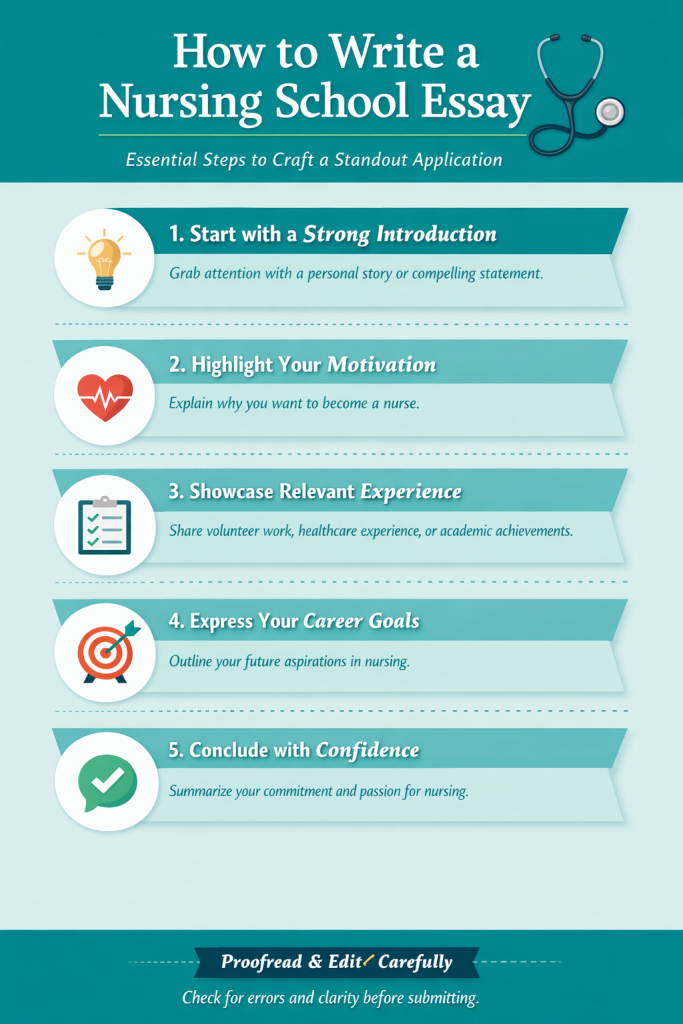
Writing your nursing school essay doesn’t need to be overwhelming. Here’s a clear, step-by-step approach to help you craft a strong and focused essay.
Step 1 — Read the Prompt Carefully
Before you begin writing, make sure you understand the essay prompt. Nursing programs may use different wording, and it’s important to align your response with the specific questions asked.
Look for key terms like motivation, leadership, experience, or goals. These will guide you on what to focus on in your essay.
Step 2 — Brainstorm Key Life Experiences
Take a moment to reflect on your life and jot down any experiences that have shaped your decision to pursue nursing. These could be moments from:
- Volunteering in healthcare settings.
- Personal caregiving experiences.
- Interactions with healthcare professionals.
Choose 2-3 experiences that are most relevant and impactful, and build your essay around them.
Step 3 — Build a Strong Outline
A well-organized outline will help keep your essay focused and clear. Your essay should have three main parts:
- Introduction: Start with a personal story or a reflection that explains why you want to become a nurse.
- Body: Discuss your key experiences and how they’ve prepared you for nursing. This is where you show the skills, qualities, and values that make you a good fit for the program.
- Conclusion: Wrap up your essay by reinforcing your motivation for nursing and how the program will help you achieve your goals.
Step 4 — Write Your Draft
Once your outline is ready, begin writing your draft. Focus on getting your ideas down without worrying about perfect grammar or structure at first. You’ll revise later.
Keep these tips in mind as you write:
- Use first-person language (“I” statements).
- Keep your sentences short and clear.
- Be honest and direct about your experiences and motivations.
Step 5 — Revise and Proofread
Once you’ve written your draft, take a break before revising. This will help you approach the essay with fresh eyes.
- Read for clarity: Ensure each paragraph flows logically to the next.
- Check for alignment: Make sure your essay addresses the prompt directly.
- Review for tone: Your essay should sound confident and professional, but also genuine and human.
After revising, use tools like Grammarly or Hemingway Editor to check for grammar and readability. Ask someone you trust, like a mentor or teacher, to review your essay for feedback.
Common Mistakes to Avoid
Even well-written essays can fall short if they make common mistakes. Here are a few to watch out for:
- Generic Statements
Avoid phrases like “I want to help people” or “Nursing has always been my dream.” Instead, use specific examples from your life that show your commitment to nursing. - Neglecting the Prompt
Make sure your essay answers the specific question posed in the prompt. If the prompt asks about leadership, focus on your leadership experiences. - Lack of Structure or Flow
A well-organized essay is easier to follow. Use clear transitions and avoid long, dense paragraphs. - Tone Issues
Keep your tone professional, but also warm and personal. Striking the right balance between emotion and professionalism is key.
Formatting and Length Guidelines
Presentation matters. A clean, professional essay shows that you care about the details. Here are some key formatting tips:
- Word Count: Most nursing schools request essays between 500 and 800 words. Stay within the specified range to show you can follow instructions.
- Font and Spacing: Use 12-point font (Times New Roman or Arial), 1-inch margins, and double-space your text.
- File Format: Save your essay as a PDF to maintain formatting, and use a professional file name like Firstname_Lastname_NursingEssay.pdf.
Conclusion — Turning Your Story Into Success
Your nursing school essay is your opportunity to showcase who you are beyond your academic records. While it’s important to be professional, the best essays are those that are authentic and sincere. They provide a clear picture of your motivation, your experiences, and why you’re a great fit for nursing school.
Remember, admissions officers are looking for genuine, compassionate individuals who are ready to take on the challenges of nursing. So, focus on telling your story honestly and confidently, and your essay will reflect the qualities they’re seeking.
When in doubt, revisit the tips and examples shared here. Your nursing school essay is an important step in your journey to becoming a nurse — so make it count.
Frequently Asked Questions
Even after finishing your essay, you may still have some lingering questions. Here are answers to the most common questions nursing school applicants ask about writing their essays.
How long should my nursing school essay be?
Most nursing schools request essays between 500 and 800 words. If no specific word count is mentioned, aim for around 650 words — this is typically the right balance between providing enough detail and staying focused.
What’s the best way to start my essay?
Start with a personal story that’s meaningful to you. Don’t use a generic quote or definition. For example, you might begin by describing a moment when you realized the importance of nursing, or an experience that inspired you to pursue the field. A strong hook engages the reader and sets the tone for the rest of your essay.
Can I reuse my essay for multiple programs?
Yes, you can reuse parts of your essay for different applications, but make sure to tailor it to each program. Mention specifics about each school and explain why you’re a good fit for their program. This shows that you’ve done your research and are genuinely interested in their specific offerings.
Should I include personal hardships or keep it academic?
You can talk about personal challenges, but focus on how you’ve grown from them. Admissions committees appreciate resilience, so explain how those challenges shaped your desire to become a nurse and what you learned from them. Avoid overly emotional or pity-driven narratives.
How can I make my essay stand out?
To make your essay stand out, focus on authenticity. Use specific experiences and vivid details to make your story memorable. Show your commitment to nursing through concrete examples rather than relying on clichés. The best essays sound like they were written by a person with a genuine passion for the profession.
