
Setting nursing professional goals is one of the smartest ways to take control of your career. Whether you’re a nursing student, new graduate, or seasoned RN, clear goals help you grow with purpose instead of drifting from one shift to the next with no clear purpose.
In this guide, you’ll find realistic nursing professional goals examples — from improving clinical skills and earning certifications to advancing into leadership roles. You’ll also learn how to write SMART nursing goals (Specific, Measurable, Achievable, Relevant, and Time-bound) that actually stick.
Think of this as your personal roadmap for growth — simple, actionable, and designed to help you become the confident, capable nurse you’ve always aimed to be.
And you’re doing it on top of work and family life. That’s exactly why we exist — to give you back your evenings, your weekends, and your peace of mind. We’ll take care of the writing. You take care of you.
Understanding Nursing Professional Goals
What Are Professional Goals in Nursing?
Professional goals are clear, actionable statements that describe how you’ll grow and what you’ll achieve. They bridge the gap between today’s practice and the nurse you’re becoming.
Common nursing professional goals examples:
- Improve patient communication and bedside rapport
- Master a clinical or technical skill
- Earn a specialty certification (CCRN, CNOR, CEN)
- Build leadership, teaching, or mentorship confidence
- Strengthen time management and prioritization on busy shifts
Well-written goals keep you motivated and focused on meaningful progress — not just task lists.
Why Nursing Goals Matter
Goals give your work structure and purpose. They help you:
- Improve patient outcomes through safer practice and clearer communication
- Advance your career by showing initiative and readiness
- Stay motivated by tracking small, steady wins
- Build confidence as your skills and impact grow
You’re not only growing for yourself — you’re growing for your patients, families, and colleagues.
Career Goals vs. Professional Development Goals
Many nurses use these terms interchangeably, but they play very different roles in your growth.
Think of career goals as the destination — where you want to go — and professional development goals as the journey — how you’ll get there day by day.
Both are essential, and understanding how they connect helps you plan smarter.
1. Career Goals – The Big Picture
Career goals describe your long-term ambitions.
They focus on advancement, new responsibilities, or transitions to higher levels of practice.
These are the goals that usually take years to achieve.
Examples:
- Earn a Master of Science in Nursing (MSN) within five years.
- Transition from bedside care to a nurse educator role.
Career goals guide your direction. They influence the choices you make about education, certifications, and where you work.
Tip: Review your career goals every year. As your interests evolve, so will your definition of success.
2. Professional Development Goals – The Everyday Growth Plan
Professional development goals are smaller, skill-focused, and tied to your current role.
They’re the habits, competencies, and behaviors that make you better right now — and prepare you for those larger career goals later.
Examples:
- Improve time management by completing documentation within 15 minutes of patient care.
- Learn to delegate effectively to nursing assistants and technicians.
These goals are usually short-term (a few weeks or months) and directly measurable.
Think of them as your “training sessions” for the big leagues — steady progress that builds confidence and competence.
3. How the Two Work Together
The secret to sustainable growth is connecting the two types.
Professional development goals create the momentum that makes your long-term career goals achievable.
Example of alignment:
- Career goal: Become a Nurse Educator in five years.
- Professional development goals:
- Complete a mentorship program for precepting new nurses.
- Improve presentation skills by leading two in-service trainings.
- Enroll in a teaching and learning course next semester.
- Complete a mentorship program for precepting new nurses.
Each short-term win supports the bigger career vision. When aligned, you avoid burnout, stay motivated, and see measurable progress.
Once you’ve outlined your career and professional development goals, the next step is turning them into something you can measure and track. That’s where SMART goal-setting comes in. The SMART framework helps you break big ambitions into clear, actionable steps — so progress never feels out of reach.
In the next section, we’ll walk through the basics of writing SMART nursing goals.
How to Write SMART Nursing Goals (Quick Overview)
Writing goals that actually stick starts with clarity. The SMART framework gives you a simple, structured way to transform a good intention into an achievable plan — something you can measure, celebrate, and build on.
SMART stands for:
- Specific – Clearly define what you want to achieve and why it matters.
- Measurable – Decide how you’ll track progress or success.
- Achievable – Keep your goal realistic within your current role and resources.
- Relevant – Align it with your practice area, patient outcomes, or career direction.
- Time-bound – Set a clear deadline to stay accountable.
When these five elements work together, your goals shift from vague wishes (“Get better at patient communication”) to actionable steps (“Use teach-back with every discharge to confirm understanding”).
Example: “Within three months, improve patient satisfaction scores by 10% through consistent use of active listening and follow-up questions during bedside interactions.”
SMART goals act as your personal blueprint — helping you see progress, stay motivated, and connect each action to a meaningful outcome.
For a deeper breakdown, templates, and ready-to-use examples, check out our full guide on Nursing SMART Goals.
Nursing Professional Goals Examples (General and By Specialty)
Nursing looks different in every setting — but the drive to grow, learn, and deliver excellent care stays the same. Whether you work in med-surg, community health, pediatrics, or the ICU, setting clear goals keeps your growth purposeful and measurable. Below you’ll find practical examples that apply to all nurses, followed by tailored goals for specific specialties.
General Nursing Professional Goals Examples
Some goals fit any role or department. They focus on core nursing values — safety, communication, teamwork, and continuous learning.
1. Strengthen patient communication
How to achieve it: Practice active listening, make eye contact, and use the teach-back method to confirm understanding.
2. Improve documentation accuracy
How to achieve it: Double-check every entry before sign-off and use standardized templates to reduce omissions.
3. Maintain 100% hand hygiene compliance
How to achieve it: Set personal reminders, monitor adherence, and support colleagues by modeling consistent behavior.
4. Enhance time management during shifts
How to achieve it: Create a task checklist, prioritize by urgency, and batch similar tasks to save time.
5. Reduce medication errors to zero
How to achieve it: Follow the “five rights” rule, use barcode scanning, and verify high-alert medications with a peer.
6. Foster teamwork and collaboration
How to achieve it: Communicate clearly during handoffs, thank coworkers for their support, and debrief after busy shifts.
7. Participate in quality improvement (QI) projects
How to achieve it: Volunteer for unit initiatives or suggest small workflow changes that enhance safety or efficiency.
8. Expand evidence-based practice knowledge
How to achieve it: Read one peer-reviewed nursing article per month and share a key takeaway with your team.
9. Complete at least two CE courses per year
How to achieve it: Use free or low-cost accredited platforms like ANA or Medline University to stay current.
10. Improve patient satisfaction scores
How to achieve it: Provide frequent updates, explain care plans clearly, and end each interaction by asking, “Do you have any questions?”
11. Mentor or precept a new nurse
How to achieve it: Volunteer as a preceptor, share your shift routines, and provide constructive feedback weekly.
12. Strengthen cultural competence
How to achieve it: Attend diversity or cultural awareness workshops and learn key phrases in commonly spoken local languages.
13. Build resilience and reduce burnout
How to achieve it: Schedule rest breaks, journal after difficult shifts, and use mindfulness exercises before work.
14. Enhance patient education
How to achieve it: Use visuals or printed guides for complex topics like medication schedules or wound care.
15. Develop leadership confidence
How to achieve it: Lead a short in-service or staff huddle once a month to practice communication and delegation skills.
These general goals form the foundation of strong nursing practice — adaptable, measurable, and centered on growth in every environment.
Nursing Professional Goals Examples by Specialty or Setting
Every nursing environment brings its own pace, pressure, and purpose. What success looks like for an ICU nurse won’t be the same for someone in pediatrics or community health. That’s why your goals should fit your environment — practical enough to achieve, but meaningful enough to push you forward.
Below are ready-to-use nursing professional goal examples by specialty — simple, realistic, and easy to customize to your role.
Medical-Surgical Nurse Goals
Med-surg nurses manage complex cases, quick turnarounds, and heavy patient loads. Success depends on accuracy, time management, and communication.
Examples:
- Improve discharge education by ensuring every patient receives a teach-back review before leaving the unit.
- Cut documentation time by 15% using EHR templates within three months.
- Complete a wound care management course this quarter.
- Hold short end-of-shift debriefs twice a week to review workflow gaps.
These goals help you balance speed with precision — the foundation of safe, efficient care.
Critical Care / ICU Nurse Goals
In the ICU, precision and calm under pressure mean everything. Your goals should blend technical mastery with teamwork and patient safety.
Examples:
- Maintain 100% compliance with CLABSI and CAUTI prevention bundles.
- Complete 20 hours of continuing education in advanced ventilator management within six months.
- Support the sepsis response initiative by ensuring early recognition and documentation in all cases.
- Cross-train with respiratory therapists to improve ventilator troubleshooting skills.
- Earn CCRN certification within the year.
ICU goals highlight competence, vigilance, and collaboration — the three hallmarks of critical care excellence.
Emergency Department (ED) Nurse Goals
In emergency care, seconds matter. Strong ED goals center on triage accuracy, teamwork, and composure under pressure.
Examples:
- Reduce triage-to-provider time for ESI level 2–3 patients by 10% within 90 days.
- Join at least one trauma simulation per quarter to maintain readiness.
- Streamline patient handoffs to under two minutes without losing key details.
- Use daily sepsis screenings on all new arrivals to improve early detection.
- Create a stress-management routine and apply it consistently during peak shifts.
These goals keep you calm, focused, and effective — even when everything moves fast.
Perioperative / OR Nurse Goals
In the OR, precision and teamwork protect every patient. Your goals should strengthen safety, coordination, and surgical flow.
Examples:
- Maintain 100% compliance with surgical safety checklists before incision.
- Reduce first-case delays by 15% through better pre-op preparation.
- Help develop a verification system to prevent retained instruments.
- Begin CNOR certification prep within six months.
- Mentor one new circulating nurse and complete their competency checklist within eight weeks.
Perioperative goals sharpen your attention to detail while reinforcing safety at every stage of care.
Pediatrics / OB / Maternity Nurse Goals
These roles blend technical skill with emotional connection — caring for families as much as patients.
Examples:
- Use visual medication charts to improve caregiver understanding during discharge.
- Achieve 95% compliance in developmental screening documentation for pediatric patients.
- Develop a handout on postpartum warning signs for all new mothers within 60 days.
- Attend a trauma-informed care workshop for children and families this quarter.
- Partner with lactation consultants to strengthen postnatal support programs.
Pediatric and maternity goals nurture empathy, communication, and education — the heart of family-centered care.
Community and Public Health Nurse Goals
Community nurses extend care beyond hospital walls. Their goals often focus on prevention, outreach, and long-term impact.
Examples:
- Coordinate two community vaccination drives in underserved areas within six months.
- Lead health education sessions for 50 residents on chronic disease prevention.
- Boost screening participation for hypertension and diabetes by 10% this quarter.
- Distribute 200 educational brochures monthly through local partners.
- Collect and analyze community feedback to improve outreach strategies by year-end.
These goals connect compassion with community impact — small actions that create lasting change.
Every specialty calls for a different kind of strength — from calm precision in critical care to creative communication in community nursing. But one principle stays constant: SMART, specific goals turn daily challenges into meaningful progress.
Structuring Your Nursing Professional Goals: Short-Term and Long-Term Growth
Once you’ve identified what you want to achieve as a nurse, the next step is deciding how to get there. Not every goal takes years to reach — some focus on building momentum right now, while others shape the nurse you’ll become in the future.
Dividing your professional goals into short-term and long-term timelines helps you stay grounded in everyday improvement while still moving toward meaningful progress. It’s the balance between today’s habits and tomorrow’s vision.
Short-Term Professional Growth Goals (0–6 Months)
Short-term goals are the building blocks of professional growth. They’re practical, attainable steps that help you improve your confidence, precision, and performance within your current role.
Examples:
- Use a time-blocked checklist for 30 days to stay organized during shifts.
- Attend one continuing education webinar or in-service this quarter.
- Apply the teach-back method with every discharge for one month.
- Reduce medication errors to zero in 60 days by double-checking high-alert drugs.
- Record all vital signs and assessments within 15 minutes of completion for four weeks.
- Give positive peer feedback twice a week to strengthen teamwork.
These short-term actions translate your professional values — accuracy, empathy, communication — into daily habits that sharpen your nursing practice.
Long-Term Professional Growth Goals (6 Months–5 Years)
Long-term goals focus on sustained development. They help you evolve from proficient to expert, preparing you for greater responsibility and leadership while deepening your clinical expertise.
Examples:
- Enroll in a BSN or MSN program within one year.
- Earn a specialty certification like CCRN, CNOR, or CEN within 12 months.
- Step into a charge nurse or educator role within two years.
- Publish a research article or lead a quality improvement project within three years.
- Develop advanced clinical expertise in your chosen specialty.
- Mentor at least three new nurses to full independence.
Long-term goals expand your professional identity. They move you from mastering skills to influencing others — through teaching, leadership, and innovation.
How Short- and Long-Term Goals Support Professional Growth
Short-term and long-term goals are two halves of the same process. The short-term builds skill and confidence; the long-term transforms that progress into lasting impact.
Example progression:
- Short-term: Attend a wound-care workshop next month.
- Long-term: Earn wound-care certification and become your unit’s go-to resource within a year.
Each short-term success supports your long-term vision — turning learning into leadership, and daily practice into professional mastery.
Once your goals are structured by timeline, the next step is to fuel them with the right knowledge. Education and certification goals provide the foundation for continued professional growth — keeping your skills sharp, your confidence high, and your career moving forward.
Education and Certification Goals to Strengthen Your Nursing Practice
Professional development in nursing doesn’t stop once you graduate or pass your boards — it’s an ongoing commitment to learning. Education and certification goals keep your knowledge fresh, your confidence high, and your clinical judgment strong. They show your dedication not just to advancement, but to providing safer, evidence-based, and more compassionate care.
Academic Advancement Goals
Further education strengthens your ability to think critically, lead teams, and adapt to a fast-changing healthcare landscape. These goals expand your professional range and ensure your practice remains grounded in research and leadership.
Examples:
- Enroll in an RN-to-BSN program within six months to deepen leadership and evidence-based practice skills.
- Apply for an MSN program within a year to prepare for advanced clinical or educator roles.
- Complete at least 15 continuing-education hours each quarter to maintain license and competency.
- Attend one nursing conference this year to learn current best practices and network with peers.
- Join a professional nursing association to access mentorship, research updates, and scholarships.
Each educational step reinforces your professional identity — helping you grow from capable practitioner to confident, forward-thinking nurse.
Specialty Certification Goals
Certifications demonstrate mastery and dedication to your field. They validate your expertise, improve patient outcomes, and set you apart as a trusted professional.
Examples:
- Earn CCRN certification within 12 months after completing required critical-care hours.
- Prepare for CNOR certification within nine months using online review modules.
- Obtain CEN certification within the next year to strengthen emergency-care proficiency.
- Gain CPHON certification in pediatric oncology within 18 months.
- Complete CNE certification within two years to transition into an educator role.
Certification goals aren’t about titles — they’re about building confidence and demonstrating excellence in your specialty.
Continuing Education and Research Goals
Professional growth means staying curious and engaged with emerging evidence. These goals keep you at the forefront of innovation and help you apply new knowledge directly to patient care.
Examples:
- Join a monthly journal club and present one evidence-based article each session.
- Submit a quality-improvement proposal to your unit’s review committee within six months.
- Present findings from a research or case study at a local conference.
- Complete a short course in nursing informatics to improve EHR accuracy and data security.
- Collaborate with a mentor on a small research project exploring patient-safety outcomes.
Continuing education transforms curiosity into competence. It ensures every decision you make at the bedside is backed by knowledge, confidence, and critical thinking.
You’ve set your goals and started building your skills — now it’s time to track results. Evaluating your progress keeps you accountable and helps you adjust before challenges become setbacks. Think of this step as your personal progress check: simple, honest, and essential for long-term growth.
How to Track and Evaluate Your Professional Nursing Goals
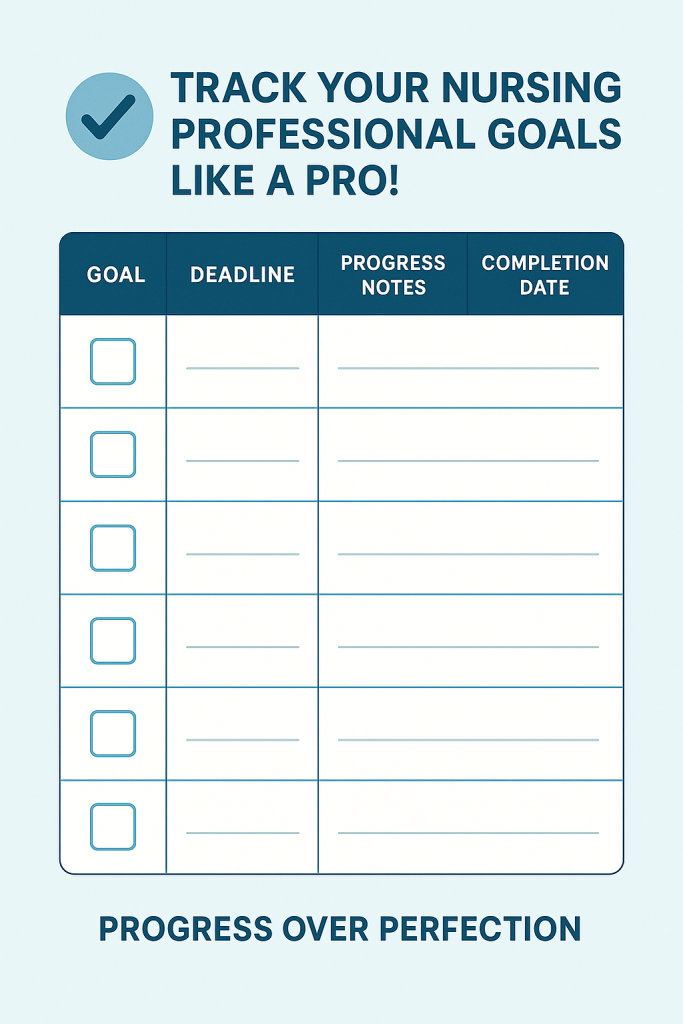
Setting professional goals is only the beginning — real progress happens when you track, reflect, and adjust them intentionally. The most successful nurses treat goal evaluation as part of their professional practice, not an afterthought. Regular check-ins keep you accountable, reveal your growth, and ensure your efforts align with your long-term career path.
1. Reflect on Professional Growth Through Self-Assessments
Reflection helps turn daily experiences into professional learning. By writing down what’s improving and what still needs focus, you gain a clearer picture of how your skills evolve over time.
Try this:
- Spend 10 minutes weekly reflecting on professional moments — clinical decisions, leadership experiences, or communication wins.
- Ask: What did I learn about my practice this week? Which skill am I strengthening?
- Note your progress on competencies like critical thinking, teamwork, or evidence-based care.
- Use digital tools (Notion, Google Docs, or nursing journal apps) to stay consistent.
Why it matters: Self-reflection transforms routine practice into a structured record of growth — something you can reference for appraisals, revalidation, or interviews.
2. Schedule Feedback and Mentorship Check-Ins
Professional growth thrives in collaboration. Feedback from mentors or supervisors helps identify blind spots and accelerate learning.
Make it a habit:
- Schedule monthly or quarterly development meetings with your preceptor or manager.
- Ask for feedback in focused areas — clinical judgment, communication, delegation, or leadership.
- Use sessions to review SMART goals and adjust your timelines.
- Offer mentorship to newer nurses — teaching reinforces your professional maturity.
Pro tip: Treat feedback as a partnership, not an evaluation. Constructive input builds self-awareness and helps align your goals with organizational priorities.
3. Use Visual Tracking Tools to Measure Professional Progress
Visual tools make your advancement tangible — especially when balancing multiple professional goals like certification, education, and QI initiatives.
Ideas that work:
- Use a progress tracker in Excel, Notion, or Trello to record milestones.
- Color-code each goal: green (achieved), yellow (in progress), red (needs attention).
- Keep your top three goals visible at your workstation or planner.
- Review and update your progress weekly or monthly.
Why it works: Seeing your professional growth — certifications earned, projects completed, or skills mastered — boosts motivation and keeps your focus forward.
4. Reassess and Adjust as You Grow
Your professional goals should evolve as your career does. What once felt challenging may now be routine, and that’s progress worth building on.
Reassess when:
- You’ve achieved a goal and need a next-level challenge.
- Your role or specialty has changed.
- Your original goal no longer fits your professional direction.
- You’ve discovered a new interest area or skill gap.
Tip: Adjusting isn’t giving up — it’s professional adaptability. Nursing is dynamic, and your goals should evolve with it.
Common Mistakes to Avoid When Setting Professional Nursing Goals
Even motivated nurses sometimes set goals that don’t stick. The issue isn’t commitment — it’s clarity and alignment. Here’s how to avoid the most common pitfalls:
1. Being Too Vague
Vague goals like “I want to be a better nurse” lack direction.
Instead: Break them down into specific, measurable actions.
Example: “Complete 10 hours of wound care training by June 30 to improve my wound assessment accuracy.”
2. Skipping Measurable Outcomes
If you can’t measure it, you can’t evaluate progress.
Fix it by asking:
- How will I know this goal is complete?
- What evidence will show success?
Example: Replace “Improve documentation” with “Submit all charting within 15 minutes of patient care for 30 days.”
3. Ignoring Alignment with Unit or Organizational Goals
When personal goals don’t align with institutional priorities, they’re harder to sustain.
Instead:
- Review your facility’s mission or departmental targets.
- Link at least one goal to a shared outcome.
Example: “Join the fall-prevention initiative to reduce patient falls by 10% this quarter.”
4. Setting Unrealistic Timelines
Ambitious timelines often lead to burnout.
Fix it:
- Focus on 1–2 major goals per quarter.
- Choose realistic timeframes (90 days works well for new habits).
- Allow flexibility — nursing life can change quickly.
5. Failing to Review or Update Goals
A stagnant goal loses value fast.
Avoid this by:
- Reviewing progress every 1–3 months.
- Replacing completed goals with fresh ones.
- Using performance appraisals or check-ins to realign priorities.
6. Neglecting Self-Care as Part of Professional Growth
You can’t grow professionally if you’re exhausted.
Remember:
- Include at least one self-care or balance-focused goal.
- Protect rest, exercise, and mental health as core components of professional readiness.
Example: “Practice five minutes of breathing or reflection before each shift to improve focus.”
Tracking your professional nursing goals keeps your growth intentional and measurable. Reflection builds awareness, feedback builds skill, and consistency builds confidence. When you treat professional development as part of your daily practice, every shift becomes a step toward your next milestone.
Staying accountable to your professional nursing goals isn’t about perfection — it’s about momentum. When you reflect regularly, seek feedback, and adjust your course, growth becomes part of your daily rhythm. Every small improvement in skill, confidence, or communication adds up to a stronger, more capable nurse. Keep your goals visible, your progress measurable, and your purpose clear — because consistent reflection today shapes the professional you’ll become tomorrow.
FAQs About Nursing Professional Goals
Setting nursing goals can feel like one more thing on your to-do list — but it doesn’t have to be complicated. Here are answers to common questions nurses ask when starting their professional growth journey.
1. What are good professional goals for a nurse?
Good goals are specific, measurable, and meaningful to your role. They improve patient care, strengthen your skills, or expand your leadership potential.
Examples:
- Improve documentation accuracy.
- Reduce patient falls or medication errors.
- Earn a certification such as CCRN or CEN.
- Mentor a new nurse or student.
- Complete a continuing education course.
The best goals help you grow while creating better outcomes for patients and your team.
2. What’s the difference between short-term and long-term nursing goals?
Short-term goals bring quick results — things you can achieve in weeks or months, like improving communication or attending a workshop.
Long-term goals require more time and consistency, such as earning a degree, gaining certification, or stepping into leadership.
Short-term goals build momentum. Long-term goals provide direction. You need both.
3. How do I write SMART goals for nursing?
Follow the SMART method:
- Specific – define the exact outcome you want.
- Measurable – add metrics to track progress.
- Achievable – keep it realistic.
- Relevant – connect it to your role or unit.
- Time-bound – set a clear deadline.
Example:
“Within three months, reduce charting errors by 25% by double-checking all documentation before submission.”
4. How often should I review or update my goals?
Check your goals at least every three months, or whenever your role or priorities shift. Frequent reviews keep your goals realistic and aligned with your current work.
A quick self-review before performance appraisals or after completing training helps you stay accountable and focused.
5. What if I don’t meet my goal on time?
Missing a goal doesn’t mean failure — it means it’s time to adjust. Reflect on what happened:
- Was your timeline too tight?
- Did other priorities get in the way?
- Was the goal still relevant?
Extend your deadline, refine your focus, and keep moving. Progress matters more than perfection.
6. Can I include professional goals on my résumé or in job interviews?
Absolutely. Concrete goals show initiative and professionalism.
Instead of writing, “Dedicated nurse passionate about patient safety,” try:
“Implemented a safety initiative that reduced patient falls by 15% in six months.”
Employers love nurses who set measurable goals — it shows accountability and leadership.
7. What are some self-care or personal growth goals for nurses?
Professional success depends on well-being. Include goals that protect your energy and mental health.
Examples:
- Practice mindfulness before or after each shift.
- Set boundaries on work communication during off-hours.
- Join a wellness or fitness challenge with coworkers.
- Take vacation days to rest and recharge.
Caring for yourself ensures you can continue caring for others — sustainably.
8. How can I stay motivated to reach my goals?
Keep your goals visible. Break them into small steps and celebrate each milestone. Surround yourself with peers and mentors who inspire you to keep going.
Motivation isn’t about nonstop drive — it’s about remembering why your goals matter.
Every goal you set — no matter how small — moves you closer to becoming a stronger, more fulfilled nurse. Progress happens one step at a time, and every effort counts.
Conclusion
Growth in nursing doesn’t happen by chance — it happens by design. Every shift teaches you something, but setting clear nursing professional goals turns those lessons into lasting progress. Whether you’re improving patient communication, earning a certification, or stepping into leadership, goal setting helps you move with purpose instead of routine.
Start small. Pick one meaningful goal for the month — maybe organizing your shift more efficiently or taking an online course. Once you’ve built consistency, add more. The secret isn’t doing everything at once; it’s doing one thing well and building from there.
And remember — your goals don’t have to match anyone else’s. Nursing offers countless paths, and each one contributes to the same mission: better care, stronger teams, and healthier communities. Every effort, no matter how small, creates a ripple effect that reaches far beyond your shift.
So take a deep breath, grab that SMART goal worksheet, and write one goal you can start today. You already have the skill, the heart, and the drive — all you need now is direction.
