
If you’re applying to nursing school or a nursing role, chances are the personal statement is the part slowing you down.
You know what you want to say. You just don’t know how to say it in a way that sounds confident, genuine, and clear—without sounding like everyone else.
That’s exactly what this guide is for.
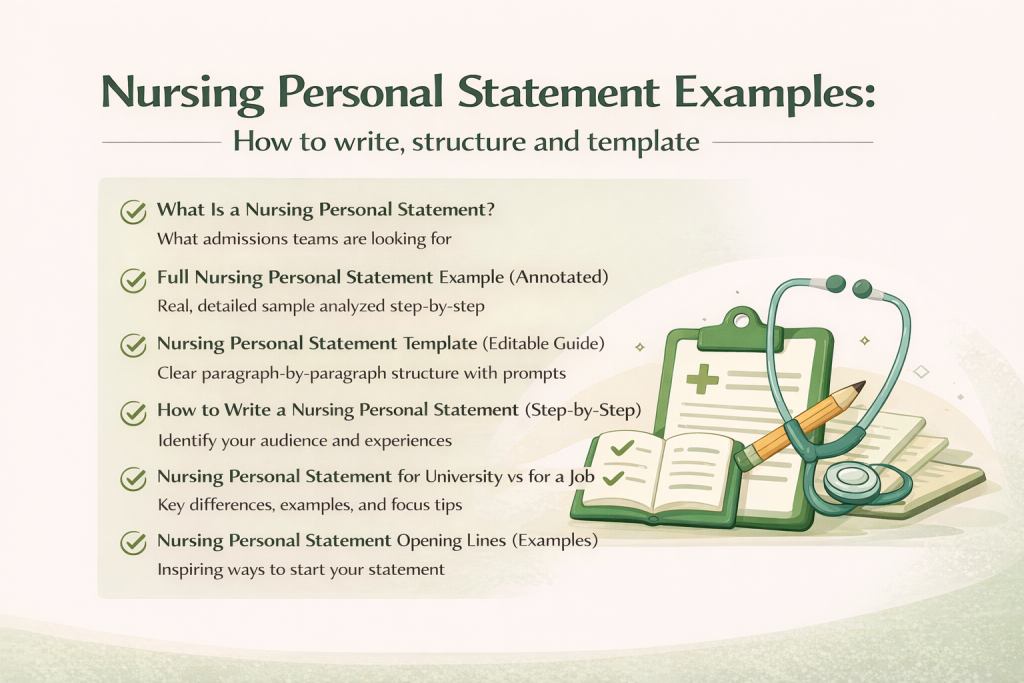
Instead of overwhelming you with dozens of examples, this article focuses on the writing process. You’ll see one full nursing personal statement example, broken down so you understand why it works. From there, you’ll learn how to write your own—step by step—using a clear structure and simple language.
You’ll also find links to specialized nursing personal statement examples, including adult nursing, children’s nursing, mental health nursing, disability nursing, and accelerated programs, so you can explore examples that match your path.
What Is a Nursing Personal Statement?
A nursing personal statement is a short piece of writing that explains why you want to study or work in nursing and why you’re a good fit for the role or program.
Unlike a CV or résumé, which lists facts, a personal statement tells a story. It shows your motivation, your values, and how your experiences have shaped your decision to pursue nursing.
Admissions teams and employers use it to answer questions like:
- Do you understand what nursing really involves?
- Can you reflect on your experiences, not just list them?
- Do your values align with patient care, teamwork, and responsibility?
- Are you ready for the emotional and practical demands of nursing?
In simple terms, your nursing personal statement connects who you are to why nursing makes sense for you.
Depending on your situation, it may be written for:
- A nursing university or college application
- An accelerated nursing program
- A nursing job or training role
While the focus changes slightly in each case, the goal stays the same: to show that your interest in nursing is thoughtful, realistic, and grounded in experience.
In the next section, we’ll break down how to write a nursing personal statement step by step, so you’re not guessing what to include or where to start.
How to Write a Nursing Personal Statement (Step-by-Step)
Writing a nursing personal statement feels hard because many people try to write it all at once. That usually leads to stress, overthinking, and sentences that don’t sound like you.
A better approach is to build it in steps. Each step has a clear purpose. When you focus on one at a time, the writing becomes much easier.
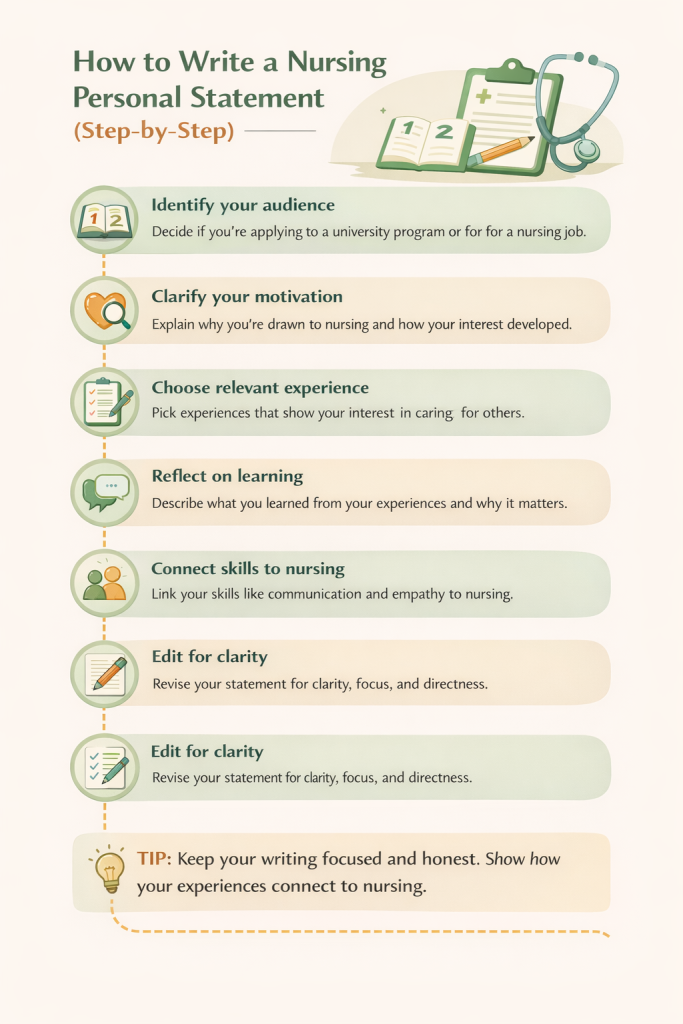
Step 1: Understand Who You’re Writing For
Before you write a single sentence, pause and ask yourself one question:
Is this personal statement for a university or for a job?
This matters more than people realize.
- University applications focus on motivation, learning, and potential.
- Job applications focus on skills, experience, and readiness to work.
The tone is professional in both cases, but the emphasis changes. If you mix the two, your statement can feel unfocused. We’ll look at the differences more closely later in this guide.
For now, be clear about your audience. It will guide every choice you make.
Step 2: Clarify Why You Want to Study or Work in Nursing
This is the heart of your nursing personal statement.
Admissions tutors and employers are not looking for dramatic stories or perfect answers. They want honesty and self-awareness.
Ask yourself:
- What first made you interested in nursing?
- What experiences confirmed that this path was right for you?
- What keeps you interested, even when the work is challenging?
Your reason does not need to be extraordinary. It needs to be real.
A short experience, a moment of care, or a gradual interest built over time is often more convincing than a dramatic life event.
Step 3: Choose Relevant Experiences (Not Everything)
One of the most common mistakes is trying to include every experience you’ve ever had.
You don’t need that.
Instead, choose experiences that show:
- Exposure to healthcare or caring roles
- Responsibility and reliability
- Communication, teamwork, or empathy
This could include:
- Work or volunteering in care settings
- School placements or shadowing
- Family caregiving
- Customer service roles that required patience and communication
What matters most is what you learned, not the job title.
Step 4: Reflect on What You Learned
This is where many nursing personal statements fall short.
Listing experiences is not enough. You need to show reflection.
For each key experience, ask:
- What did this teach me about nursing?
- How did it change my understanding of patient care?
- What skills or values did I develop?
Reflection shows maturity. It tells the reader you can learn from experience, which is essential in nursing.
Step 5: Connect Your Skills to Nursing
Nursing requires more than compassion. Your personal statement should also show that you understand the practical side of the role.
You might reflect on skills such as:
- Communication
- Time management
- Emotional resilience
- Teamwork
- Attention to detail
You don’t need to name every skill directly. Often, showing them through examples is more effective.
Step 6: Keep Your Writing Clear and Focused
Strong nursing personal statements are easy to read.
As you write:
- Keep sentences short and clear
- Avoid long, complicated phrases
- Stay focused on nursing, not unrelated life stories
If a sentence doesn’t help explain why nursing or why you, it probably doesn’t need to be there.
In the next section, we’ll bring all of this together by looking at nursing personal statement structure, using a simple outline you can follow when you start drafting.
Nursing Personal Statement Structure (Simple Example Outline)
Once you know what to write, the next challenge is where everything goes.
A clear structure keeps your nursing personal statement focused and easy to follow. It also helps the reader understand your story without having to work for it. Admissions tutors and hiring managers read many statements, often back-to-back. A logical flow matters.
Below is a simple structure that works well for most nursing applications. You don’t need to follow it word for word, but it’s a strong starting point.
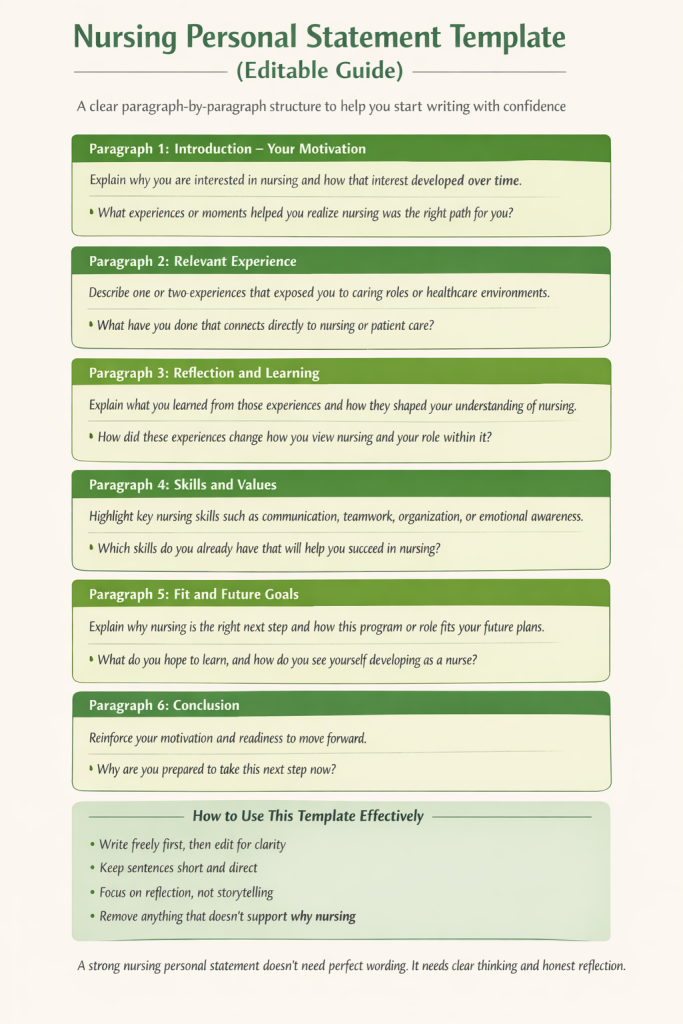
1. Introduction: Your Motivation for Nursing
This is where you briefly explain why nursing interests you.
A strong opening:
- Introduces your motivation clearly
- Sets a calm, confident tone
- Feels personal, not generic
You don’t need to tell your entire story here. One clear idea is enough. Think of this as inviting the reader into your reasoning, not trying to impress them.
2. Relevant Experience: What You’ve Done
Next, talk about experiences that connect you to nursing or patient care.
This might include:
- Work or volunteering in healthcare or care settings
- Shadowing or placements
- Caring for others in a personal context
- Roles that required responsibility, communication, or empathy
Focus on quality, not quantity. One or two well-chosen experiences are better than a long list with no depth.
3. Reflection: What You Learned
This is where your statement becomes strong.
For each experience you mention, explain:
- What you learned about caring for others
- How the experience shaped your understanding of nursing
- What it taught you about yourself
Reflection shows growth. It tells the reader that you can learn from experience and apply that learning moving forward.
4. Skills and Values: Why You’re a Good Fit
Here, you connect your experiences to the skills needed in nursing.
You might reflect on:
- Communication and teamwork
- Emotional awareness and resilience
- Organization and time management
- Respect for patients and confidentiality
Rather than listing skills, show them through short examples. This keeps your writing natural and believable.
5. Fit and Future Goals: Why This Path Makes Sense
In this part, explain why nursing is the right next step for you.
You can briefly touch on:
- Why you want to study nursing or work in this role
- What you hope to learn or contribute
- How this program or position fits your long-term goals
This shows direction and commitment, without needing to sound overly confident or dramatic.
6. Conclusion: Looking Ahead
Your conclusion should feel calm and forward-looking.
A strong ending:
- Reinforces your motivation for nursing
- Shows readiness for the next stage
- Leaves a positive, confident impression
You don’t need to repeat everything you’ve said. One or two focused sentences are enough.
This structure gives you a clear path from start to finish. In the next section, we’ll look at a full nursing personal statement example and walk through it so you can see how this structure works in real writing.
Full Nursing Personal Statement Example (Annotated)
Below is a complete nursing personal statement example. It’s written in a clear, realistic tone and follows the structure we just discussed.
As you read it, don’t focus on copying the wording. Pay attention to how ideas are introduced, developed, and connected.
Example: Nursing Personal Statement
My interest in nursing developed through a combination of personal experience and hands-on exposure to caring roles. I have always been drawn to work that involves supporting others, but it was during my time volunteering at a local care home that I began to understand what nursing truly involves. Observing how nurses balanced clinical responsibilities with compassion showed me that nursing is both practical and deeply human.
While volunteering, I assisted residents with daily activities and spent time speaking with individuals who often felt isolated. These interactions taught me the importance of patience, clear communication, and respect for dignity. I learned that small actions, such as listening carefully or explaining what is happening, can significantly improve a person’s comfort and trust. This experience confirmed that I am motivated by work that directly improves the wellbeing of others.
In addition to volunteering, I have developed transferable skills through my academic studies and part-time employment. Managing my responsibilities required strong time management and organization, particularly when balancing coursework with work commitments. Working as part of a team also helped me understand the importance of cooperation and clear communication, skills that are essential in healthcare settings where patient safety depends on teamwork.
These experiences have shaped my understanding of nursing as a role that demands emotional awareness, responsibility, and continuous learning. I am particularly interested in developing my clinical skills while maintaining a patient-centred approach to care. I understand that nursing can be challenging, but I am prepared for this and motivated by the opportunity to make a meaningful contribution.
I am now eager to build on my experiences through formal nursing education. I believe that studying nursing will allow me to develop the knowledge, skills, and professional values required to provide safe and compassionate care. I am committed to learning, self-reflection, and growth, and I look forward to taking the next step toward a career in nursing.
Why This Nursing Personal Statement Works
This example is effective because it does a few important things well:
- Clear motivation early on
The opening explains how the interest in nursing developed, without exaggeration or clichés. - Relevant experience, not overloading
It focuses on one main volunteering experience and develops it properly, instead of listing many roles. - Reflection is built in
The writer explains what they learned and how it shaped their understanding of nursing. - Skills are shown, not listed
Skills like communication and time management are demonstrated through examples. - Calm, confident ending
The conclusion looks ahead without sounding unrealistic or overconfident.
This is the level of clarity and reflection you should aim for—not perfection, but thoughtful connection between experience and motivation.
Nursing Personal Statement Examples by Specialization
Not all nursing personal statements are written with the same focus. What admissions teams look for can change depending on the nursing pathway you’re applying to.
Below is a brief overview of the most common nursing specializations, along with links to dedicated example pages for each one. These pages include multiple full examples so you can see how tone, experience, and emphasis shift by field.
Adult Nursing Personal Statement Examples
Adult nursing personal statements often focus on:
- Patient-centred care
- Teamwork in fast-paced environments
- Communication with patients and families
- Managing responsibility and pressure
If you’re applying for adult nursing, your statement should show that you understand the realities of caring for adults across different health needs and settings.
→ View adult nursing personal statement examples (3–5 full examples)
Children’s (Child) Nursing Personal Statement Examples
Children’s nursing requires a slightly different emphasis.
Strong children’s nursing personal statements usually highlight:
- Communication with both children and parents
- Emotional awareness and patience
- Safeguarding and responsibility
- Adaptability in care approaches
These examples show how applicants demonstrate empathy and professionalism while working with young patients.
→ View children’s nursing personal statement examples
Mental Health Nursing Personal Statement Examples
Mental health nursing personal statements place greater weight on:
- Reflection and self-awareness
- Understanding vulnerability and stigma
- Emotional resilience
- Building trust and therapeutic relationships
If you’re interested in mental health nursing, your statement should show insight into both the challenges and the importance of this field.
→ View mental health nursing personal statement examples
Disability Nursing Personal Statement Examples
Disability nursing personal statements often focus on:
- Advocacy and respect for dignity
- Inclusive, person-centred care
- Long-term support and relationship building
- Understanding diverse physical and intellectual needs
These examples demonstrate how applicants connect personal values with professional responsibility.
→ View disability nursing personal statement examples
Accelerated Nursing Personal Statement Examples
Accelerated nursing programs are often aimed at:
- Career changers
- Mature students
- Applicants with prior degrees or professional experience
Personal statements for these programs usually highlight:
- Transferable skills
- Motivation for career transition
- Readiness for intensive study
→ View accelerated nursing personal statement examples
Exploring examples that match your intended pathway can make it much easier to shape your own statement. As you read them, look for patterns, not perfect wording
Next, we’ll tackle one of the most common sticking points:
Nursing Personal Statement Opening Lines (Examples)
The opening line of your nursing personal statement matters more than people think.
It sets the tone, shows confidence, and tells the reader what kind of writer you are. A weak opening doesn’t usually ruin a statement—but a strong one makes the reader want to keep going.
The goal is clarity, not drama.
Below are examples of effective opening lines, followed by a quick explanation of why they work.
Example Opening Lines
1.
“My interest in nursing developed through hands-on experience in care settings, where I saw the impact compassionate and skilled nursing can have on patients and families.”
Why it works:
Clear, calm, and focused. It shows motivation without exaggeration.
2.
“Through volunteering and academic study, I have developed a strong understanding of the responsibilities and challenges involved in nursing, which has confirmed my desire to pursue this career.”
Why it works:
It shows reflection and realism, not a sudden or emotional decision.
3.
“My decision to pursue nursing is based on a growing interest in patient care and a desire to work in a role that combines practical skills with empathy and responsibility.”
Why it works:
Simple and honest. It connects values to the role.
4.
“Working in a supportive care environment allowed me to observe the role of nurses closely and understand the importance of patient-centred care.”
Why it works:
It grounds motivation in real exposure, not assumptions.
5.
“I am motivated to study nursing because it offers the opportunity to support individuals during vulnerable moments while working within a professional healthcare team.”
Why it works:
Balanced and mature. It avoids clichés while showing awareness.
What to Avoid in Opening Lines
Some openings weaken an otherwise good personal statement. Try to avoid:
- Overly dramatic life stories in the first sentence
- Claims like “I have always wanted to be a nurse” with no context
- Long, complicated sentences
- Quotes or definitions of nursing
If your opening sounds calm, clear, and believable, you’re on the right track.
Next, we’ll look at the other end of the statement—something many applicants struggle with just as much.
How to End a Nursing Personal Statement (With Examples)
The ending of your nursing personal statement should feel confident and forward-looking, not dramatic or repetitive.
You don’t need to summarize everything you’ve already said. A strong conclusion simply reinforces:
- your motivation for nursing,
- your readiness to take the next step,
- and your commitment to learning and development.
Below are examples of effective ways to end a nursing personal statement, followed by brief guidance.
Example Ending Line
1.
“I am now motivated to develop my skills and understanding through nursing education, and I am committed to contributing positively to patient care and professional practice.”
Why it works:
It looks ahead without making unrealistic promises.
2.
“I believe that studying nursing will allow me to build on my experiences and develop the knowledge and values required to provide safe, compassionate care.”
Why it works:
Clear connection between past experience and future goals.
3.
“I am eager to continue learning within a structured nursing program and to develop the skills necessary to support patients with professionalism and empathy.”
Why it works:
Professional, calm, and focused on growth.
4.
“I am confident that nursing aligns with my values and abilities, and I am ready to take the next step toward a career dedicated to patient-centred care.”
Why it works:
Shows readiness without sounding overconfident.
Common Ending Mistakes to Avoid
- Introducing new experiences at the very end
- Repeating the introduction word-for-word
- Making exaggerated claims about changing lives
- Ending too abruptly with a single vague sentence
A good rule of thumb: if your ending feels steady and thoughtful, it’s doing its job.
Nursing Personal Statement Template (Editable Guide)
If you’re staring at a blank page and not sure how to begin, this template gives you a clear starting point. It follows the structure we’ve already discussed and can be adapted for most nursing applications.
Use it as a guide, not a script. Your goal is to sound like you, not like a template.
Nursing Personal Statement for University vs for a Job
One reason nursing personal statements get rejected is simple: they’re written for the wrong audience.
A personal statement for a university application is not the same as one written for a nursing job, even though they may look similar on the surface.
Understanding the difference helps you choose the right focus, tone, and examples.
| Feature | Nursing Personal Statement for University | Nursing Personal Statement for a Job |
| Primary focus | Potential and readiness to learn | Competence and readiness to work |
| Main purpose | Show why you want to study nursing and develop professionally | Show what you can contribute in a nursing role right now |
| What the reader wants to know | Why nursing interests you and how you think | How well you can perform safely and professionally |
| Experience emphasis | Learning from experience | Applying skills in real settings |
| Reflection | Strong focus on growth and development | Used to support performance and decision-making |
| Skills highlighted | Communication, empathy, willingness to learn | Communication, teamwork, accountability, reliability |
| Tone | Developmental and reflective | Professional and outcome-focused |
| Overall message | “I’m ready to become a nurse.” | “I’m ready to do the job.” |
Nursing Personal Statement Writing Tips
Once you have a draft, the goal shifts from writing to refining. Many nursing personal statements fail not because the ideas are wrong, but because the message gets lost in unclear writing.
These tips will help you strengthen your statement without overcomplicating it.
Keep Your Language Simple and Direct
Clear writing is a strength, not a weakness.
- Use short sentences where possible
- Avoid long, complex phrases
- Say what you mean the first time
If a sentence feels hard to read out loud, it probably needs simplifying.
Show Reflection, Not Just Experience
Admissions teams and employers want to see how you think.
Instead of only describing what you did, explain:
- what you learned,
- what challenged you,
- and how the experience shaped your understanding of nursing.
Reflection shows maturity and readiness.
Stay Focused on Nursing
Every paragraph should connect back to nursing.
Before keeping a sentence, ask yourself:
Does this help explain why nursing is right for me?
If the answer is no, consider removing it—even if it’s well written.
Avoid Clichés and Overused Phrases
Phrases like “I have always wanted to be a nurse” or “I want to help people” are common and vague.
Instead:
- explain how your interest developed,
- show what helping others looks like in practice.
Specific examples are always more convincing than general statements.
Edit More Than Once
Strong personal statements are revised, not rushed.
Try this simple editing process:
- First edit: clarity and structure
- Second edit: reflection and relevance
- Final edit: grammar, spelling, and flow
If possible, step away for a day before your final review. Fresh eyes catch small issues.
Conclusion
Writing a nursing personal statement can feel overwhelming, but it becomes much more manageable when you break it down into clear steps.
You don’t need dramatic stories or perfect wording. What matters most is that your statement shows honest motivation, thoughtful reflection, and a clear understanding of nursing. When you focus on why this path makes sense for you—and support that with real experiences—your writing naturally becomes stronger.
Use the structure and template in this guide as a foundation. Study the full example carefully, then explore the specialization-specific nursing personal statement examples that match your intended pathway. Those examples are there to help you recognize patterns, not to copy language.
Take your time, revise thoughtfully, and keep your writing clear and direct. A well-written nursing personal statement doesn’t try to impress—it helps the reader understand you.
Next, we’ll answer some of the most common questions about nursing personal statements so you can move forward with confidence.
Frequently Asked Questions About Nursing Personal Statements
What should a nursing personal statement include?
A strong nursing personal statement usually includes:
- Your motivation for choosing nursing
- Relevant experience or exposure to caring roles
- Reflection on what you’ve learned
- Skills and values linked to nursing
- A clear reason why this next step makes sense
You don’t need to include everything you’ve ever done. Focus on what best explains why nursing is right for you.
What is a personal statement for nursing school?
A personal statement for nursing school explains why you want to study nursing and why you’re a suitable applicant.
It helps admissions teams understand:
- your interest in nursing,
- your awareness of the profession,
- and your readiness to learn and develop.
It is not a CV. It should focus on motivation and reflection, not just achievements.
How do you write a nursing personal statement if you have no experience?
You don’t need formal healthcare experience to write a strong nursing personal statement.
You can draw from:
- volunteering or community work,
- caring for family members,
- customer service or support roles,
- school projects or group work.
What matters most is how you reflect on what you learned and how those experiences connect to nursing.
How long should a nursing personal statement be?
Length requirements vary, so always check the application guidelines.
In general:
- University applications are often 500–800 words
- Job applications may be shorter and more focused
If no limit is given, aim for a statement that is detailed but concise. Every paragraph should serve a purpose.
How do you start a nursing personal statement?
Start with a clear, calm explanation of how your interest in nursing developed.
Good openings:
- feel natural,
- avoid clichés,
- and connect to real experience.
You don’t need a dramatic first line. Clarity and honesty work better.
How do you end a nursing personal statement?
End by looking forward.
A strong ending:
- reinforces your motivation,
- shows readiness for the next step,
- and leaves a confident impression.
Avoid introducing new experiences at the end. Keep the focus on growth and commitment.
Why do you want to study nursing? How should you answer this?
This question is about understanding and reflection, not passion alone.
A good answer explains:
- how your interest developed,
- what you understand about nursing,
- and why this path fits your values and goals.
Specific examples always work better than general statements.
