
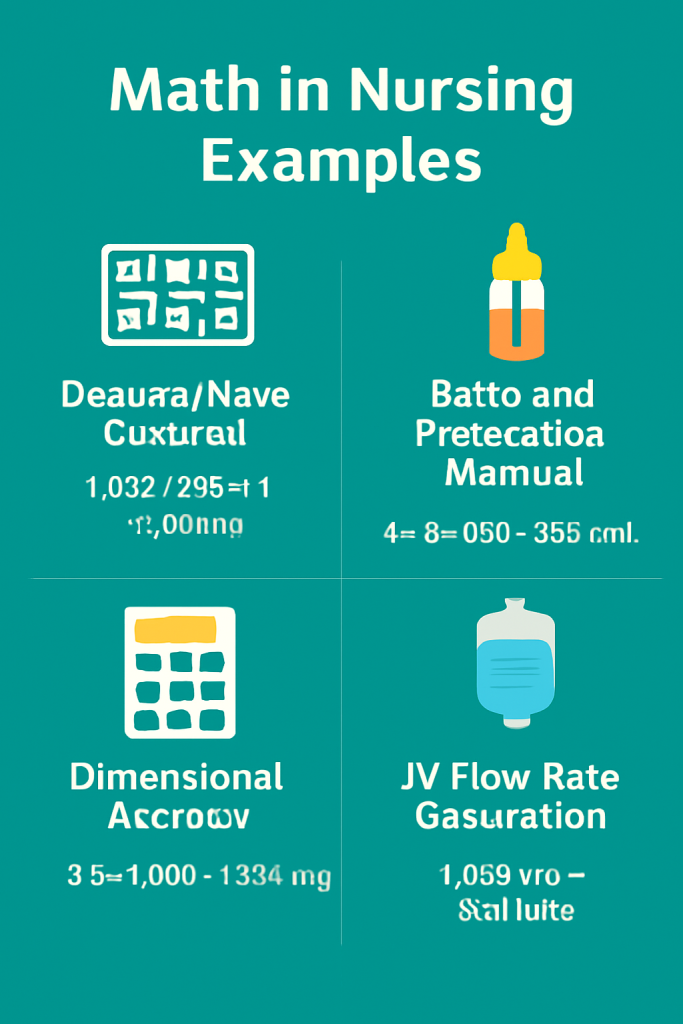
You might not have imagined yourself crunching numbers when you first decided to become a nurse, but here’s the reality: math plays a vital role in your daily work. From calculating the right medication doses to ensuring IV drips run at the correct rate, math is a tool you’ll use to make sure your patients get the right care. Don’t worry, though — nursing math isn’t as complex as it seems. With a few essential formulas and some practice, you’ll feel confident handling these calculations. Ready to tackle nursing math with ease? Let’s dive into the basics.
Let our nursing writing team help you cross one more thing off your list — with care, accuracy, and compassion. You rest. We’ll write.
The 3 Core Calculation Methods in Nursing
Nursing math boils down to just a few core methods. Let’s walk through each of them, giving you the tools to handle almost any calculation you encounter on the job.
Desired/Have Formula (D/H × Q)
This is probably the formula you’ll use the most when working with dosages. It’s straightforward: figure out what you need, what you have, and how to get from one to the other.
- Formula: Desired dose (D) ÷ Have on hand (H) × Quantity (Q)
Example:
Problem: A doctor orders 1,200 mg, but your stock is 600 mg tablets. How many tablets do you need to give?
Solution: (1,200 ÷ 600) × 1 = 2 tablets.
This method is perfect for any time you’re working with medication that’s available in a set amount, like pills or vials.
When to use:
This formula is your go-to for medication dosage calculations. Whether you’re administering oral tablets, injectable medications, or IV solutions, it ensures you’re giving the right amount.
Ratio and Proportion Method
Sometimes you’ll need to solve problems where two ratios or proportions are involved. This method lets you calculate the unknown by setting up a proportion that matches the given relationship.
- Formula: Ratio 1 = Ratio 2 (cross-multiply and solve for x)
Example:
Problem: If 5 mL contains 250 mg, how many mL are needed for 500 mg?
Solution:
(5 mL ÷ 250 mg) = (x mL ÷ 500 mg)
Now, solve for x:
x = (5 × 500) ÷ 250 = 10 mL.
This method is handy when you need to adjust doses based on concentration, such as with injectable medications or when working with liquid forms.
When to use:
This formula is ideal for weight-based calculations or when you’re working with dilutions or concentrations. It’s especially useful for pediatric medication, IV rates, and fluids.
Dimensional Analysis (Factor-Label Method)
Dimensional analysis, also known as the factor-label method, is a bit like solving a puzzle. You cancel out units to convert one measurement to another.
- Formula: Multiply by conversion factors to cancel units and solve.
Example:
Problem: Convert 2.5 grams to milligrams.
Solution:2.5 g × (1,000 mg ÷ 1 g) = 2,500 mg.
This method works wonders when you’re switching between different units like milligrams to grams, milliliters to liters, or even miles to kilometers.
When to use:
It’s perfect for any situation where you need to convert measurements (for example, from metric to standard units).
Common Math Examples in Nursing
Medication Dosage Calculation
Let’s break down a few scenarios where medication dosage calculations are essential for safe patient care.
Oral Medications
Imagine a scenario where you need to give your patient 500 mg of a medication, but your stock is 250 mg tablets. Using the Desired/Have formula, you can quickly figure out that you need two tablets to meet the prescribed dose.
Formula: (500 ÷ 250) × 1 = 2 tablets.
This approach is useful for any oral medication calculation.
Injection Dosages
For injections, you’ll often use the weight-based calculation, especially for pediatric patients.
Example: If a doctor orders 2 mg/kg for a 70 kg patient, you’ll need 140 mg in total.
Formula: 2 mg × 70 kg = 140 mg.
This ensures that the dose is adjusted based on the patient’s body weight.
Liquid Medications
Sometimes, you’ll be asked to administer liquid medications, where you need to know how many milliliters to give.
Example: If you have a 200 mg/5 mL concentration, and you need to administer 600 mg, the calculation will look like this:
(5 mL ÷ 200 mg) × 600 mg = 15 mL.
IV Flow Rate Calculation
IV calculations are crucial when you’re managing fluids or administering medication via infusion.
mL/hr Calculation
If your patient needs 1,000 mL over 8 hours, you’ll calculate how much fluid to give per hour.
Formula: 1,000 ÷ 8 = 125 mL/hr.
You’ll set the IV drip rate to 125 mL per hour.
gtt/min Calculation
For drop factor calculations, you’ll use the drop factor (gtt/mL) and time to figure out how fast the IV should be running.
Example: You need to infuse 500 mL in 2 hours, and the drop factor is 20 gtt/mL.
Formula: (500 ÷ 120 minutes) × 20 = 83.33 gtt/min.
Pediatric Fluid Calculation
Pediatric fluid requirements often depend on weight and age. For example, a pediatric patient needing 1.5 mL/hr per kg of body weight would require a different rate calculation based on their size.
Essential Conversions Nurses Must Know
As a nurse, it’s important to quickly convert between units. Whether it’s from milliliters to liters or milligrams to grams, these conversions help you safely administer the correct amount of medication.
Metric Conversions
Here are some of the most important conversions to remember:
- 1 mL = 1 cc
- 1 liter = 1,000 mL
- 1 gram = 1,000 mg
- 1 kilogram = 2.2 pounds
Example: Convert 100 mg to g.
Solution: 100 mg = 0.1 g.
Household Measurements
In addition to metric conversions, you may also need to convert household measurements.
Example: Convert 2 tablespoons to milliliters.
Solution: 2 tbsp = 30 mL.
Weight-Based Dosing in Pediatrics and Adults
Pediatric Dosage Calculations
For pediatric patients, weight-based calculations are often necessary. The general rule is to use mg/kg to determine the correct dose.
Example:
Formula: 10 mg/kg × 12 kg = 120 mg.
Adult Dosage Adjustments
Adults may also require adjusted doses based on their weight or specific medical conditions.
Example:
If the doctor orders 250 mg/kg for a 60 kg adult, the calculation would be:
Formula: 250 mg × 60 kg = 15,000 mg.
Medication Safety: Why Double-Checking Math is Critical
You’ve learned the formulas, but now comes the most important part: safety. Medication errors can happen, and math mistakes are often the culprit.
The “Six Rights” of Medication Administration
Make sure you’re following these crucial steps every time:
- Right patient
- Right medication
- Right dose
- Right route
- Right time
- Right documentation
These rights ensure that you’re giving the right medication, in the right dose, to the right patient, at the right time, and by the right method. When you double-check your math, you’re also protecting these rights.
Common Medication Math Errors and How to Avoid Them
Here are some common mistakes to watch for:
- Using incorrect units: Double-check mg vs mL.
- Misreading labels: Always confirm medication concentration and dosage.
- Forgetting to round properly: Follow rounding rules to ensure accuracy and safety.
By being vigilant about your math, you can avoid these errors and give the safest care possible.
Practice and Study Tips for Nursing Students
Practice Methods for Mastering Nursing Math
It’s time to practice, practice, practice. Regularly doing problems will reinforce your skills and help you feel confident when it’s time for clinicals or exams.
- Use interactive quizzes for dosage calculations and IV rates.
- Create study flashcards for conversions and formulas.
How to Study Math for Nursing Exams (e.g., NCLEX)
- Focus on key methods: Practice the Desired/Have formula and IV flow rate calculations.
- Study in short, focused sessions: Aim for 20-minute bursts, followed by a short break. This helps maintain focus without burnout.
Practice makes perfect — the more problems you solve, the more confident you’ll feel with math in nursing.
Frequently Asked Questions (FAQ)
How Much Math Do Nurses Actually Use?
Don’t worry, you won’t be doing calculus in the ER. Most math in nursing involves basic arithmetic like addition, subtraction, multiplication, and division. While some nurses may deal with more complex math, the majority of what you’ll encounter are simple, everyday calculations — and they’re easy to master with practice.
Do I Need Advanced Math for Nursing?
Not at all! Nursing math is designed to be simple and practical, focusing on essential calculations like dosages, conversions, and IV rates. As long as you’re comfortable with basic math, you’ll be fine. You don’t need a degree in mathematics to become an excellent nurse — just practice and attention to detail.
What are the Most Common Math Errors in Nursing?
Here are the most common mistakes to watch out for:
- Miscalculating doses by confusing units like mg vs mL.
- Misreading medication labels or failing to double-check concentrations.
- Not rounding correctly — be sure to follow your institution’s rounding rules to avoid errors.
Where Can I Find More Practice Problems for Nursing Math?
Look for practice sets in nursing textbooks or online resources. Many sites offer free quizzes that mirror real-world nursing scenarios, which is a great way to reinforce your learning. Additionally, mobile apps can be a fun and convenient way to practice calculations on the go.
Conclusion: Mastering Math for Safe and Effective Nursing Care
At the end of the day, nursing math isn’t about complex formulas—it’s about ensuring you administer the right medication at the right dose, on time, and in the safest way possible. With practice, you’ll find that math is more than manageable — it’s an essential skill that can help you provide the best care for your patients. Don’t be intimidated by math; embrace it as a tool that makes your nursing practice more effective and your patient outcomes safer. So, grab your calculator, and let’s get to work!
