
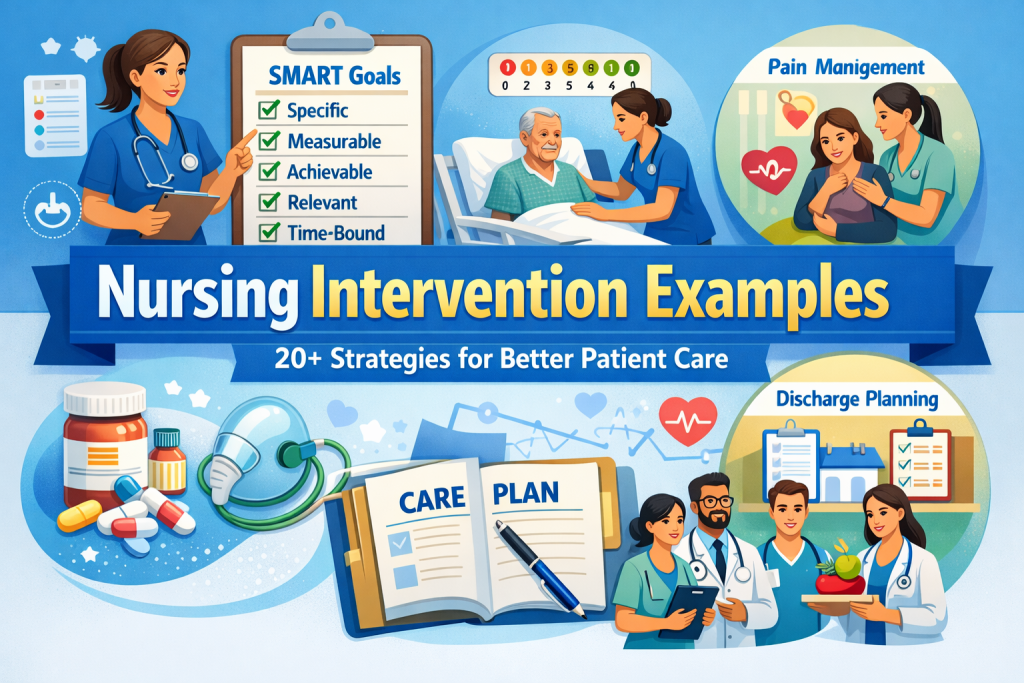
Nursing interventions are the actions that nurses take to improve patient outcomes. These interventions transform general care into specific, actionable steps that directly impact a patient’s recovery. Whether you’re supporting someone after surgery, helping manage a chronic condition, or promoting overall wellness, your interventions are crucial for achieving the best possible results.
In this guide, we’ll explore over 20 nursing intervention examples, providing real-world scenarios to help you write better care plans, enhance patient safety, and improve outcomes. From addressing pain management to hypertension and anxiety, we’ll cover interventions for a wide range of clinical conditions.
What Is A Nursing Intervention
Nursing interventions are the doing part of nursing. They’re the actions that turn assessment data and care plans into real support at the bedside, in the community, or wherever your patient is. When done well, they create a clear link between what you identify as a problem and what you actively do to improve it.
Definition and Key Concepts
A nursing intervention is any action you take, as a nurse, to address a patient’s health need, reduce risk, or improve outcomes. These actions can be physical, educational, emotional, or preventive. Some are simple. Others require coordination and clinical judgment. All of them should be intentional.
Nursing interventions don’t exist in isolation. They fit directly into the nursing process, which acts as your clinical roadmap:
- Assessment – You collect data and notice patterns.
- Diagnosis – You identify the patient’s actual or potential problems.
- Planning – You decide what needs to be done and why.
- Implementation – You carry out the nursing interventions.
- Evaluation – You check whether those interventions worked.
Here’s the key idea many students miss:
Interventions are the bridge between diagnosis and outcome.
If your intervention doesn’t clearly connect to the diagnosis—or can’t be evaluated—it doesn’t belong in the care plan.
The Purpose of Nursing Interventions
Nursing interventions are not random tasks or routine checkboxes. Each one should serve a clear purpose. When you look at strong nursing intervention examples, you’ll usually see one (or more) of these goals in action.
1. Improving Patient Outcomes
This is the core purpose. Interventions should help the patient:
- Heal faster
- Prevent complications
- Maintain function
- Adapt to illness or injury
For example, repositioning a patient every two hours isn’t “busy work.” It’s a targeted intervention to prevent pressure injuries and protect skin integrity.
2. Patient Education
Many nursing interventions focus on teaching—because informed patients make safer decisions.
This can include:
- Medication education
- Lifestyle changes
- Symptom monitoring
- Post-discharge self-care
When education is written clearly as an intervention, it shows foresight and long-term thinking, not just task completion.
3. Promoting Safety
Safety-focused interventions aim to reduce risk before harm occurs. These are especially important for high-risk patients, such as those who are elderly, confused, post-op, or immunocompromised.
Examples include:
- Fall prevention strategies
- Infection control measures
- Medication safety checks
Strong safety interventions are proactive, not reactive.
4. Supporting Holistic Well-Being
Patients are more than diagnoses. Nursing interventions also address:
- Emotional stress
- Anxiety and fear
- Family dynamics
- Social and cultural needs
Supporting a patient’s mental and emotional state often improves physical outcomes too. This is where nursing judgment really shines.
Types of Nursing Interventions
Understanding nursing intervention classification helps you choose the right action—and explain why it’s appropriate. Most nursing interventions fall into one of three categories.
| Type of Nursing Intervention | Description | Examples |
| Independent Nursing Interventions | Actions you can initiate without a provider’s order, relying on clinical judgment and nursing scope. | – Teaching relaxation or breathing techniques- Repositioning patients to prevent pressure injuries- Providing emotional reassurance- Encouraging mobility or fluid intake |
| Dependent Nursing Interventions | Actions that require a provider’s order but are carried out by the nurse. | – Administering prescribed medications- Initiating oxygen therapy as ordered- Performing treatments or procedures per protocol |
| Interdependent (Collaborative) Nursing Interventions | Actions carried out in collaboration with other healthcare professionals, reflecting teamwork. | – Working with physical therapy on a mobility plan- Collaborating with dietary for nutritional support- Coordinating discharge planning with case management |
Nursing Intervention Examples
Now that we’ve broken down the key concepts behind nursing interventions, let’s dive into some real-world examples. This section will give you a better understanding of how to apply these interventions across different patient scenarios. We’ll cover a variety of categories, so you can see how nursing interventions fit into different contexts. Ready? Let’s go!
A. Family Nursing Interventions
Family-centered care is a critical aspect of nursing practice. Often, family members play a significant role in the patient’s healing and recovery. Nursing interventions that focus on family support not only address the patient’s physical needs but also provide the emotional and educational tools their loved ones need to care for them.
- Teaching Breastfeeding Techniques to New Mothers
- New mothers can often feel unsure about breastfeeding. By providing hands-on demonstrations or teaching techniques with a doll, nurses help build the mother’s confidence and ensure that the baby is getting the proper nutrition. It’s a small action with a big impact on both maternal and infant health.
- New mothers can often feel unsure about breastfeeding. By providing hands-on demonstrations or teaching techniques with a doll, nurses help build the mother’s confidence and ensure that the baby is getting the proper nutrition. It’s a small action with a big impact on both maternal and infant health.
- Holding a Family Meeting for Dementia Patients
- Dementia can be a challenging diagnosis for both patients and their families. By facilitating family meetings, nurses can help coordinate care, set clear goals, and provide emotional support. These meetings also ensure everyone is on the same page, which can improve care coordination and reduce family stress.
- Dementia can be a challenging diagnosis for both patients and their families. By facilitating family meetings, nurses can help coordinate care, set clear goals, and provide emotional support. These meetings also ensure everyone is on the same page, which can improve care coordination and reduce family stress.
Family interventions like these recognize that patient care extends beyond the individual and that the patient’s family is often key to the healing process. These types of interventions are just as important as the ones provided directly to the patient.
B. Behavioral Nursing Interventions
Behavioral interventions focus on helping patients change unhealthy habits or adopt new coping strategies, and they are often centered around mental health. These interventions help address the psychological and emotional aspects of care—something every nurse should be prepared for.
- Deep Breathing Exercises Before a Painful Procedure
- Procedures like blood draws or wound dressing changes can cause anxiety or pain. Teaching the patient deep breathing exercises beforehand can lower their stress levels, making the procedure more manageable. It’s a simple intervention that can significantly reduce pain and anxiety.
- Procedures like blood draws or wound dressing changes can cause anxiety or pain. Teaching the patient deep breathing exercises beforehand can lower their stress levels, making the procedure more manageable. It’s a simple intervention that can significantly reduce pain and anxiety.
- Smoking Cessation Strategies and Stress Management
- Smoking is a leading cause of chronic disease, but quitting can feel overwhelming. Nurses can provide tailored advice, help patients set achievable goals, and offer stress management alternatives like relaxation techniques. Over time, these interventions lead to better long-term health outcomes by reducing disease risk.
- Smoking is a leading cause of chronic disease, but quitting can feel overwhelming. Nurses can provide tailored advice, help patients set achievable goals, and offer stress management alternatives like relaxation techniques. Over time, these interventions lead to better long-term health outcomes by reducing disease risk.
Behavioral interventions often require patience and empathy, as changing long-term habits or addressing mental health challenges takes time. But when done right, these interventions can have a lasting impact on the patient’s overall well-being.
C. Physiological Nursing Interventions
Physiological interventions are the foundation of nursing practice. These interventions address the physical health needs of the patient, ensuring that basic care is provided and more complex issues are managed appropriately.
- Assisting Post-Op Patients with Hygiene
- After surgery, many patients may be unable to perform basic hygiene tasks themselves. Helping patients maintain personal hygiene doesn’t just prevent infections; it also supports their dignity and comfort. This simple act can make a big difference in the patient’s recovery and emotional well-being.
- After surgery, many patients may be unable to perform basic hygiene tasks themselves. Helping patients maintain personal hygiene doesn’t just prevent infections; it also supports their dignity and comfort. This simple act can make a big difference in the patient’s recovery and emotional well-being.
- Repositioning Immobile Patients Every 2 Hours to Prevent Bedsores
- Bedsores (pressure ulcers) are a common complication for patients who are immobile for extended periods. Repositioning patients every 2 hours prevents these painful and dangerous sores from forming. It’s a critical nursing intervention that not only improves patient comfort but also prevents long-term complications.
- Bedsores (pressure ulcers) are a common complication for patients who are immobile for extended periods. Repositioning patients every 2 hours prevents these painful and dangerous sores from forming. It’s a critical nursing intervention that not only improves patient comfort but also prevents long-term complications.
For nurses, physiological interventions are often the most direct and tangible way to help patients. Whether it’s managing pain, preventing complications, or aiding recovery, these interventions are essential for improving the patient’s physical health and overall recovery.
D. Community Nursing Interventions
Community nursing interventions focus on the health of populations rather than individuals. These interventions aim to improve public health, prevent disease, and promote wellness within communities. Nurses play a critical role in outreach and education for entire groups, particularly in underserved or high-risk populations.
- Blood Pressure Screenings in Community Centers
- High blood pressure is a common, often undiagnosed condition. By offering blood pressure screenings at local community centers, nurses help detect hypertension early, allowing for timely intervention. This can prevent long-term complications like stroke, heart disease, and kidney damage.
- High blood pressure is a common, often undiagnosed condition. By offering blood pressure screenings at local community centers, nurses help detect hypertension early, allowing for timely intervention. This can prevent long-term complications like stroke, heart disease, and kidney damage.
- Running Flu Vaccine Clinics in Underserved Areas
- Flu vaccines save lives. But many underserved populations have limited access to healthcare facilities. By organizing and running vaccine clinics in these communities, nurses can provide life-saving prevention, reducing the spread of flu and minimizing hospital admissions during flu season.
- Flu vaccines save lives. But many underserved populations have limited access to healthcare facilities. By organizing and running vaccine clinics in these communities, nurses can provide life-saving prevention, reducing the spread of flu and minimizing hospital admissions during flu season.
Community interventions are essential in making healthcare more accessible, reducing disparities, and promoting public health. These types of interventions often involve collaboration with local health organizations and community leaders.
E. Safety Nursing Interventions
Safety is always the top priority in nursing care. Safety interventions aim to prevent harm, reduce risk, and ensure that patients are as safe as possible during their care. These interventions are particularly critical in high-risk settings like hospitals and nursing homes.
- Verifying Patient Identity with Two Identifiers Before Administering Medications
- Medication errors can have serious, even fatal, consequences. By using two patient identifiers (such as name and date of birth) before administering any medication, nurses ensure that the correct medication is given to the right patient, reducing the risk of medication errors.
- Medication errors can have serious, even fatal, consequences. By using two patient identifiers (such as name and date of birth) before administering any medication, nurses ensure that the correct medication is given to the right patient, reducing the risk of medication errors.
- Using Fall Precautions for Patients with Limited Mobility
- Falls are one of the leading causes of injury in healthcare settings. For patients with limited mobility or those recovering from surgery, fall precautions like bed alarms, non-slip socks, and keeping the environment clear of hazards can significantly reduce the risk of falls and injuries.
- Falls are one of the leading causes of injury in healthcare settings. For patients with limited mobility or those recovering from surgery, fall precautions like bed alarms, non-slip socks, and keeping the environment clear of hazards can significantly reduce the risk of falls and injuries.
Safety interventions may seem like small steps, but they are essential in preventing harm and ensuring that patients can receive their care in the safest environment possible.
F. Health System Nursing Interventions
Health system interventions focus on improving the efficiency and quality of care within healthcare facilities. These interventions are aimed at optimizing care delivery, ensuring that patients receive timely, effective, and coordinated care from the moment they enter the facility until discharge.
- Creating Discharge Checklists to Ensure Patient Education
- When patients are discharged from the hospital, there is often a lot of information they need to retain, such as medication instructions, follow-up appointments, and self-care techniques. By creating a discharge checklist, nurses can ensure that the patient and their family understand the discharge instructions, reducing the risk of readmission and improving the patient’s long-term outcomes.
- When patients are discharged from the hospital, there is often a lot of information they need to retain, such as medication instructions, follow-up appointments, and self-care techniques. By creating a discharge checklist, nurses can ensure that the patient and their family understand the discharge instructions, reducing the risk of readmission and improving the patient’s long-term outcomes.
- Collaborating with Case Managers for Home Health Services
- For patients who need ongoing care after discharge (e.g., wound care, physical therapy), collaborating with case managers to arrange home health services ensures that care continues smoothly once the patient leaves the hospital. This intervention improves continuity of care and promotes safe transitions from hospital to home.
- For patients who need ongoing care after discharge (e.g., wound care, physical therapy), collaborating with case managers to arrange home health services ensures that care continues smoothly once the patient leaves the hospital. This intervention improves continuity of care and promotes safe transitions from hospital to home.
These interventions help streamline care within the healthcare system, ensuring that patients continue to receive high-quality support even after they leave the hospital.
G. Nutritional Nursing Interventions
Nutrition plays a huge role in a patient’s recovery and health, so nutritional interventions are a key part of nursing care. Nurses often need to assess and implement strategies that support a patient’s dietary needs, especially in patients with chronic conditions or those who are recovering from surgery.
- Providing Nutritional Support for Diabetic Patients
- Diabetes requires careful monitoring of dietary intake, especially carbohydrates. Nurses can work with dietitians to help patients understand how to balance their meals and manage blood glucose levels. Offering practical tips, such as portion control and reading food labels, can make a big difference in the patient’s long-term health.
- Diabetes requires careful monitoring of dietary intake, especially carbohydrates. Nurses can work with dietitians to help patients understand how to balance their meals and manage blood glucose levels. Offering practical tips, such as portion control and reading food labels, can make a big difference in the patient’s long-term health.
- Encouraging Fluid Intake in Dehydrated Patients
- Dehydration can lead to a variety of complications, from kidney stones to poor wound healing. Encouraging and monitoring fluid intake, especially in patients who are vomiting, on diuretics, or elderly, can prevent dehydration and support overall recovery.
- Dehydration can lead to a variety of complications, from kidney stones to poor wound healing. Encouraging and monitoring fluid intake, especially in patients who are vomiting, on diuretics, or elderly, can prevent dehydration and support overall recovery.
H. Pain Management Interventions
Pain management is one of the most common and critical aspects of nursing care. Effective pain management can improve a patient’s quality of life, speed up recovery, and reduce complications.
- Administering Pain Medication as Prescribed
- One of the most direct ways to manage pain is by administering prescribed pain medications. Nurses must ensure that the medication is given on time and monitor for side effects to ensure safety and effectiveness.
- One of the most direct ways to manage pain is by administering prescribed pain medications. Nurses must ensure that the medication is given on time and monitor for side effects to ensure safety and effectiveness.
- Providing Non-Pharmacological Pain Relief
- Alongside medications, non-pharmacological interventions—such as guided imagery, music therapy, or ice/heat packs—can help reduce pain perception and improve comfort. These are often used alongside pharmacological interventions to provide holistic pain management.
- Alongside medications, non-pharmacological interventions—such as guided imagery, music therapy, or ice/heat packs—can help reduce pain perception and improve comfort. These are often used alongside pharmacological interventions to provide holistic pain management.
I. Respiratory Nursing Interventions
Respiratory health is a vital aspect of nursing care, especially in patients with respiratory illnesses or post-surgery. Interventions that support optimal oxygenation and lung function are crucial for recovery.
- Administering Oxygen Therapy as Ordered
- Patients with conditions like COPD, asthma, or pneumonia often require oxygen therapy to maintain proper oxygen saturation levels. Administering oxygen as prescribed helps prevent hypoxia, improves energy levels, and aids in tissue healing.
- Patients with conditions like COPD, asthma, or pneumonia often require oxygen therapy to maintain proper oxygen saturation levels. Administering oxygen as prescribed helps prevent hypoxia, improves energy levels, and aids in tissue healing.
- Encouraging Deep Breathing and Incentive Spirometer Use
- Deep breathing exercises help expand the lungs and prevent atelectasis (lung collapse), especially in post-surgical patients. Encouraging the use of an incentive spirometer can help patients achieve this goal and improve lung function after surgery or during respiratory illness.
- Deep breathing exercises help expand the lungs and prevent atelectasis (lung collapse), especially in post-surgical patients. Encouraging the use of an incentive spirometer can help patients achieve this goal and improve lung function after surgery or during respiratory illness.
J. Psychological and Mental Health Nursing Interventions
Mental health is an essential part of overall well-being, and psychological nursing interventions focus on supporting patients’ emotional and mental health needs. These interventions can help reduce stress, manage anxiety, and support patients coping with mental health challenges.
- Providing Emotional Support to Patients with Chronic Illness
- Chronic illness can lead to feelings of isolation, anxiety, and depression. Nurses can offer emotional support by actively listening, providing reassurance, and connecting patients with mental health resources when necessary.
- Chronic illness can lead to feelings of isolation, anxiety, and depression. Nurses can offer emotional support by actively listening, providing reassurance, and connecting patients with mental health resources when necessary.
- Using Cognitive Behavioral Therapy Techniques for Stress Management
- Cognitive Behavioral Therapy (CBT) can help patients manage anxiety or depression by teaching them to recognize and challenge negative thoughts. Nurses can use basic CBT techniques to help patients develop healthier thought patterns, improving their emotional well-being.
K. Pediatric Nursing Interventions
In pediatric nursing, interventions need to be tailored not only to the child’s condition but also to their developmental stage and family dynamics.
- Administering Immunizations According to Schedule
- Immunizations are a cornerstone of pediatric healthcare, preventing serious illnesses. Ensuring timely administration of vaccines helps keep children protected from preventable diseases, contributing to public health as well.
- Immunizations are a cornerstone of pediatric healthcare, preventing serious illnesses. Ensuring timely administration of vaccines helps keep children protected from preventable diseases, contributing to public health as well.
- Providing Play Therapy to Relieve Anxiety
- For younger children, play therapy can serve as an effective tool for reducing anxiety and improving emotional well-being. It allows children to express their feelings and cope with hospital stays or medical treatments in a non-threatening way.
L. Geriatric Nursing Interventions
Older adults often have unique healthcare needs, and geriatric nursing interventions are designed to address those. These interventions focus on improving quality of life, managing chronic conditions, and ensuring patient safety.
- Monitoring for Signs of Elderly Abuse or Neglect
- Elderly patients are at risk for abuse or neglect, particularly in caregiving situations. Nurses must stay vigilant for signs of abuse, such as unexplained bruising or changes in behavior, and intervene appropriately to ensure patient safety.
- Elderly patients are at risk for abuse or neglect, particularly in caregiving situations. Nurses must stay vigilant for signs of abuse, such as unexplained bruising or changes in behavior, and intervene appropriately to ensure patient safety.
- Managing Medications for Multiple Chronic Conditions
- Many elderly patients have multiple chronic conditions that require medication management. Nurses can help by reviewing prescriptions, checking for drug interactions, and coordinating care with other healthcare providers to optimize the patient’s medication regimen.
- Many elderly patients have multiple chronic conditions that require medication management. Nurses can help by reviewing prescriptions, checking for drug interactions, and coordinating care with other healthcare providers to optimize the patient’s medication regimen.
M. Palliative and End-of-Life Nursing Interventions
End-of-life care is an important aspect of nursing, ensuring patients are comfortable and supported during their final stages. Palliative care interventions focus on pain relief, emotional support, and providing dignity during the dying process.
- Providing Pain Management for Terminally Ill Patients
- One of the main goals in palliative care is to alleviate suffering. Administering pain medication effectively and using non-pharmacological techniques like massage or music therapy helps improve the patient’s quality of life during their final days.
- One of the main goals in palliative care is to alleviate suffering. Administering pain medication effectively and using non-pharmacological techniques like massage or music therapy helps improve the patient’s quality of life during their final days.
- Supporting Family Members in End-of-Life Care
- Families of terminally ill patients need emotional support as well. Nurses can provide guidance on how to care for the patient, assist with decision-making, and offer emotional support to the family during this difficult time.
- Families of terminally ill patients need emotional support as well. Nurses can provide guidance on how to care for the patient, assist with decision-making, and offer emotional support to the family during this difficult time.
How to Write a Nursing Intervention
Writing a nursing intervention isn’t just about checking tasks off a list. It’s about crafting clear, measurable, and actionable steps that will improve the patient’s condition. A well-written intervention outlines exactly what needs to be done, who will do it, and how the intervention will help the patient achieve their health goals. Let’s break it down.
Steps to Writing a Nursing Intervention
- Identify the Diagnosis or Need
The first step in writing any nursing intervention is understanding the patient’s diagnosis or health issue. What’s the problem you’re trying to address? This could be a physical condition, like pain or shortness of breath, or a psychological issue, like anxiety or distress.
- Example:
- Diagnosis: Risk for Impaired Skin Integrity
- Intervention: “Reposition the patient every 2 hours to prevent pressure ulcers.”
- Diagnosis: Risk for Impaired Skin Integrity
- Be Specific and Actionable
Once you’ve identified the diagnosis, the next step is to write the intervention in a way that is clear and actionable. Avoid vague language and instead be as specific as possible about what needs to be done. This also helps make the intervention measurable, so you can track its effectiveness.
- Example:
- Vague: “Assist the patient with hygiene.”
- Specific: “Assist the patient with brushing their teeth and washing their face twice daily to maintain hygiene and prevent infection.”
- Vague: “Assist the patient with hygiene.”
- Use the SMART Goal Framework
The SMART goal framework helps you create interventions that are not only actionable but also trackable and measurable. It stands for:
- Specific: What exactly will be done?
- Measurable: How will you measure success?
- Achievable: Is this intervention realistic for the patient?
- Relevant: Does it align with the patient’s diagnosis or needs?
- Time-bound: When will this intervention be completed or how often will it happen?
- Example:
- SMART Intervention: “Reposition the patient every 2 hours to prevent pressure ulcers, aiming to maintain intact skin during the hospital stay.”
- SMART Intervention: “Reposition the patient every 2 hours to prevent pressure ulcers, aiming to maintain intact skin during the hospital stay.”
- Use Action Verbs
An intervention is only as effective as the action it drives. Be sure to use strong, actionable verbs that tell exactly what will be done. This makes the intervention clear and ensures that everyone involved in the patient’s care knows what is expected.
- Examples of action verbs:
- Assist
- Teach
- Monitor
- Administer
- Provide
- Encourage
- Assist
- Example:
- Vague: “The nurse will talk to the patient about stress.”
- Actionable: “The nurse will teach the patient 4-7-8 breathing exercises every morning and evening to reduce stress levels by 2 points on the GAD-7 scale within 3 days.”
- Vague: “The nurse will talk to the patient about stress.”
- Collaboration and Scope of Practice
While nurses often work independently, many interventions require collaboration with other healthcare providers. When writing your intervention, note if you need to work alongside other professionals, such as physicians, physical therapists, or social workers.
- Example:
- Intervention: “Collaborate with the dietitian to create a high-protein meal plan and monitor nutritional intake to meet 1,800 kcal/day by Day 4.”
- Intervention: “Collaborate with the dietitian to create a high-protein meal plan and monitor nutritional intake to meet 1,800 kcal/day by Day 4.”
- Include a Rationale
A strong intervention doesn’t just tell what to do—it also explains why the action is necessary. Providing a rationale for your intervention helps clarify its importance and reinforces its relevance to the patient’s needs and diagnosis.
- Example:
- Intervention: “Teach the patient how to use the incentive spirometer every 2 hours while awake to promote lung expansion and prevent atelectasis.”
- Rationale: “Using the incentive spirometer helps keep the lungs expanded, reducing the risk of pneumonia and improving oxygenation.”
- Intervention: “Teach the patient how to use the incentive spirometer every 2 hours while awake to promote lung expansion and prevent atelectasis.”
How to Use SMART Goals in Nursing Interventions
Now that we’ve explored how to write effective nursing interventions, let’s talk about how to make them even more actionable and measurable by using SMART goals. If you’re not already familiar with the concept, SMART goals are a proven framework that can help you focus your interventions, track progress, and ensure you’re providing the best possible care. It stands for:
- Specific
- Measurable
- Achievable
- Relevant
- Time-bound
Let’s break down each element and see how you can apply it to your nursing interventions.
1. Specific: Clearly Define the Action
A specific goal should be clear and unambiguous. It answers the questions: What exactly will you do? and Why is it important?
For example:
- Not specific: “Help the patient with pain.”
- Specific: “Administer prescribed pain medication (e.g., acetaminophen 500mg) every 4 hours to manage the patient’s post-operative pain.”
2. Measurable: Track Progress
A measurable goal has clear criteria for tracking progress. This means you should be able to look at the goal and ask, How will I know if this intervention is working? You need numbers, data, or other measurable outcomes to assess the effectiveness of your intervention.
For example:
- Not measurable: “Encourage the patient to drink more water.”
- Measurable: “Encourage the patient to drink at least 1 liter of water per day, and monitor urine output every shift.”
3. Achievable: Set Realistic Goals
An achievable goal is one that is realistic, given the patient’s condition, resources, and the nurse’s scope of practice. You want to ensure the goal is possible to achieve within the set timeframe.
For example:
- Not achievable: “The patient will walk 3 miles a day, starting tomorrow.”
- Achievable: “The patient will walk 100 feet with assistance by Day 2 after surgery.”
4. Relevant: Align with Patient’s Needs
A relevant goal is one that directly aligns with the patient’s diagnosis, needs, and health priorities. You want to ensure that your nursing intervention is aligned with what matters most for the patient’s recovery or well-being.
For example:
- Not relevant: “Teach the patient how to use an incentive spirometer every hour” (for a patient with no respiratory concerns).
- Relevant: “Teach the patient how to use the incentive spirometer every 2 hours while awake to prevent pneumonia after surgery.”
5. Time-bound: Set a Deadline or Frequency
Finally, a time-bound goal has a clear timeframe or deadline. It answers the question, When will this goal be completed? It could be a specific date or a frequency like “every shift” or “daily.”
For example:
- Not time-bound: “The patient will reduce their pain levels.”
- Time-bound: “The patient will report a pain level of 3 or below on a 0-10 scale within 48 hours after surgery.”
Example of a SMART Goal in Practice
Let’s pull everything together into a real-life SMART goal.
- Diagnosis: Risk for Impaired Skin Integrity
- SMART Goal: “The nurse will reposition the patient every 2 hours to prevent pressure ulcers, with the goal of maintaining intact skin during the hospital stay.”
Here’s how it breaks down:
- Specific: Reposition the patient every 2 hours to prevent pressure ulcers.
- Measurable: The goal is to maintain intact skin during the hospital stay.
- Achievable: Repositioning every 2 hours is a realistic action for the nurse to carry out.
- Relevant: The intervention directly addresses the patient’s risk of pressure ulcers.
- Time-bound: The goal is focused on the duration of the hospital stay, which gives a clear timeframe.
Why SMART Goals Matter
SMART goals are the gold standard in nursing interventions. They ensure that your interventions are clear, measurable, and focused. They also make it easier to evaluate whether the intervention is working, and whether adjustments need to be made to improve patient outcomes.
By using SMART goals, you can track progress, avoid vague or irrelevant actions, and ensure that every intervention has a clear purpose and timeframe.
Using the NIC (Nursing Interventions Classification) System
In nursing, there’s a system designed to help you standardize and classify interventions: the Nursing Interventions Classification (NIC) system. Whether you’re working on care plans for clinical assignments or real-life patient care, this classification system can help you choose interventions that are evidence-based and consistent across the nursing profession.
Let’s take a closer look at the NIC system, why it’s important, and how you can use it to make your interventions even more effective.
What is the NIC System?
The Nursing Interventions Classification (NIC) system is a comprehensive, standardized system that categorizes more than 550 nursing interventions. Each intervention includes:
- A definition of the intervention
- Specific activities or actions involved
- The desired outcomes or goals of the intervention
- A class code for easy referencing
Developed by the University of Iowa, the NIC system is designed to provide clarity and uniformity in nursing practice, especially in care planning and documentation. It helps ensure that interventions are evidence-based, consistent, and aligned with nursing best practices.
How to Use the NIC System in Nursing Care Plans
Using the NIC system to write nursing interventions is straightforward once you understand its structure. Here’s how you can apply it to your practice:
- Identify the Patient’s Needs or Diagnosis
Start by identifying the patient’s diagnosis or health concern. From there, look for interventions in the NIC system that align with the patient’s condition. - Choose the Most Relevant Intervention(s)
Once you’ve identified the diagnosis, browse through the NIC to find interventions that directly address the problem. There are 7 main domains in the NIC system, each containing several classes of interventions:
- Physiological: Basic (e.g., oral hygiene, feeding)
- Physiological: Complex (e.g., airway management, hemodynamic monitoring)
- Behavioral (e.g., anxiety reduction, coping enhancement)
- Safety (e.g., fall prevention, suicide precautions)
- Family (e.g., family support, parenting education)
- Health System (e.g., discharge planning, care coordination)
- Community (e.g., immunization administration, screening)
- Physiological: Basic (e.g., oral hygiene, feeding)
- Integrate NIC Codes into Your Care Plan
Each NIC intervention has a unique class code (e.g., 0221 for Ambulation) that you can reference in your care plan. This helps you stay organized and ensures that the care plan is structured according to a standardized system. - Monitor and Evaluate the Intervention
After implementing the intervention, evaluate its effectiveness based on patient outcomes. The NIC system includes outcome measures that help you track whether the intervention has met its goals.
Examples of NIC System Interventions
Let’s look at a few examples of NIC interventions and see how they’re applied in nursing practice:
- NIC 0221: Ambulation
- Intervention: “Assist patient to walk 10 feet twice daily with a gait belt, as tolerated.”
- Rationale: Ambulation helps improve circulation, mobility, and independence in patients recovering from surgery or illness.
- Intervention: “Assist patient to walk 10 feet twice daily with a gait belt, as tolerated.”
- NIC 5820: Anxiety Reduction
- Intervention: “Teach the patient grounding techniques and validate fears during stressful periods.”
- Rationale: Reducing anxiety improves a patient’s ability to cope with health challenges and promotes better physical and emotional outcomes.
- Intervention: “Teach the patient grounding techniques and validate fears during stressful periods.”
- NIC 6490: Fall Prevention
- Intervention: “Place the patient’s bed in the lowest position, use non-slip socks, and ensure the call light is within reach.”
- Rationale: Fall prevention strategies are essential for reducing injuries, especially in older or immobile patients.
- Intervention: “Place the patient’s bed in the lowest position, use non-slip socks, and ensure the call light is within reach.”
By using NIC codes and selecting the most appropriate interventions, you can streamline your care plans, standardize documentation, and ensure that you’re providing evidence-based care that aligns with best practices.
Why Use NIC in Your Practice?
The NIC system isn’t just a tool for nurses in academic settings—it’s a practical, real-world resource that enhances care delivery. By using NIC, you:
- Ensure consistency in your documentation and interventions.
- Communicate more effectively with the entire healthcare team.
- Stay aligned with evidence-based practices.
- Improve patient outcomes by using proven interventions.
If you’re serious about providing the best care possible, the NIC system is an invaluable tool in your nursing toolkit.
Conclusion
Nursing interventions are the cornerstone of patient care. They ensure that the care you provide is not only thoughtful and comprehensive but also targeted to produce measurable outcomes. Whether you’re helping a patient manage pain, educating them on post-surgery care, or working with the healthcare team to optimize care plans, your interventions make a real difference.
In this article, we’ve covered over 20 nursing intervention examples across various categories, from family support to pain management, behavioral interventions, and safety precautions. These examples will help you apply real-world knowledge to your nursing practice, allowing you to craft better, more effective care plans.
But, knowing how to write nursing interventions is just the beginning. By using the SMART goal framework and Nursing Interventions Classification (NIC) system, you can ensure that your interventions are specific, measurable, achievable, relevant, and time-bound.
Takeaway: Strong interventions are focused, measurable, and patient-centered. By clearly defining goals, using precise actions, and collaborating with other healthcare professionals, you can create care plans that improve patient outcomes—and ensure their recovery is as smooth and effective as possible.
FAQs About Nursing Interventions Examples
Even with a well-defined care plan and clear interventions, there may still be questions lingering about nursing interventions. In this section, we’ll address some frequently asked questions (FAQs) to help clarify common concerns and provide more insight into effective intervention strategies.
How Many Interventions Should Be Included Per Diagnosis?
You might be wondering, how many interventions are enough? In most cases, 2–4 nursing interventions per diagnosis is the sweet spot. Here’s why:
- 1 Independent Intervention: This is an action you initiate based on your nursing judgment. It should be directly related to the patient’s needs, such as providing education or performing a procedure like repositioning a bedridden patient.
- 1 Dependent Intervention: This is an action that requires a provider’s order, such as administering medication or performing a diagnostic test.
- 1 Interdependent (Collaborative) Intervention: This intervention involves working with other healthcare professionals to provide holistic care, such as collaborating with a physical therapist for mobility support.
- 1 Measurable Action: It’s important to make sure that one of your interventions has clear measurable outcomes so you can assess progress. This ensures your care plan has measurable goals and doesn’t just focus on vague tasks.
What’s the Best Example of a Nursing Intervention?
There’s no one-size-fits-all answer to this, as the best intervention depends on the patient’s diagnosis and unique needs. However, a good nursing intervention is always:
- Specific to the patient’s diagnosis and needs.
- Actionable, with clear steps that can be easily followed.
- Measurable, so progress can be tracked and adjustments can be made as necessary.
- Relevant to the patient’s goals and health outcomes.
- Time-bound, with a set deadline or frequency.
For example:
- Diagnosis: Acute Pain
- Intervention: “Administer prescribed pain medication as ordered every 4 hours, monitor pain level, and evaluate effectiveness.”
- Rationale: Ensuring pain relief helps improve comfort, support recovery, and promote better patient outcomes.
How Do You Prioritize Nursing Interventions?
When multiple interventions are needed, prioritization is key. You’ll want to follow frameworks like the ABC rule (Airway, Breathing, Circulation) and Maslow’s Hierarchy of Needs to determine which interventions take precedence.
- ABC Framework:
- Airway: Interventions related to airway management take top priority.
- Breathing: Interventions that ensure the patient is breathing adequately.
- Circulation: Ensure that the patient’s heart and circulation are functioning properly.
- Airway: Interventions related to airway management take top priority.
- Maslow’s Hierarchy of Needs:
Maslow’s theory suggests that physiological needs (like air, water, and sleep) take precedence over psychological needs (like self-esteem or social needs). As a nurse, you’ll prioritize interventions that address life-threatening issues first, followed by those that support basic needs, then move on to higher-level concerns.
For example:
- Diagnosis: Ineffective Airway Clearance
- Top priority intervention: “Suction the patient PRN to maintain oxygen saturation above 92%.”
What’s the Highest Priority Nursing Intervention?
When it comes to prioritizing interventions, consider critical needs first. The most urgent interventions often involve life-threatening conditions, such as:
- Airway clearance
- Breathing support
- Circulatory support (like blood pressure regulation)
For non-life-threatening diagnoses, consider Maslow’s Hierarchy of Needs to address basic physiological concerns before moving to safety, social, or psychological needs.
For example:
- Diagnosis: Risk for Injury (due to limited mobility)
- High-priority intervention: “Place the bed in the lowest position and activate the bed alarm to prevent falls.”
