
What Nursing Health Promotion Is
In nursing, health promotion refers to actions that help people improve, maintain, or protect their health over time. It focuses on reducing risk factors, supporting healthy behaviors, and helping patients manage their health more effectively, rather than responding only after illness occurs.
Health promotion is part of routine nursing practice. It happens during assessments, medication reviews, discharge teaching, and brief patient interactions. When a nurse explains why a lifestyle change matters, reinforces preventive care, or supports self-management, that nurse is practicing health promotion.
This guide focuses on nursing health promotion examples that students are expected to recognize and explain in exams, clinicals, and care plans. The goal is to make health promotion easy to identify and simple to apply.
Health Promotion Strategies Used in Nursing
Health promotion in nursing relies on a small set of practical strategies that are used across settings and patient populations. These strategies focus on prevention, understanding, and long-term behavior change.
Common health promotion strategies include:
- Supporting lifestyle and behavior change
- Providing targeted health education
- Encouraging early screening and risk awareness
- Building self-management skills
- Connecting patients to supportive resources
These strategies are usually delivered in short, focused interactions. Nurses adjust their approach based on the patient’s health status, understanding, and willingness to engage.
Health Promotion and Disease Prevention in Nursing
Health promotion and disease prevention are closely related but not identical. Understanding the difference helps students answer exam questions correctly and plan appropriate nursing care.
Health promotion focuses on improving overall health and supporting healthy behaviors before problems develop or worsen. Disease prevention focuses more specifically on reducing the likelihood of illness or detecting it early.
In practice, nurses often combine both approaches. Encouraging physical activity promotes long-term health, while blood pressure screening helps prevent complications by identifying risk early. Both support better outcomes, but health promotion emphasizes empowerment and sustained behavior change.
Recognizing this overlap helps clarify why many nursing interventions serve both health promotion and disease prevention goals.
Nursing Health Promotion Examples by Strategy Category
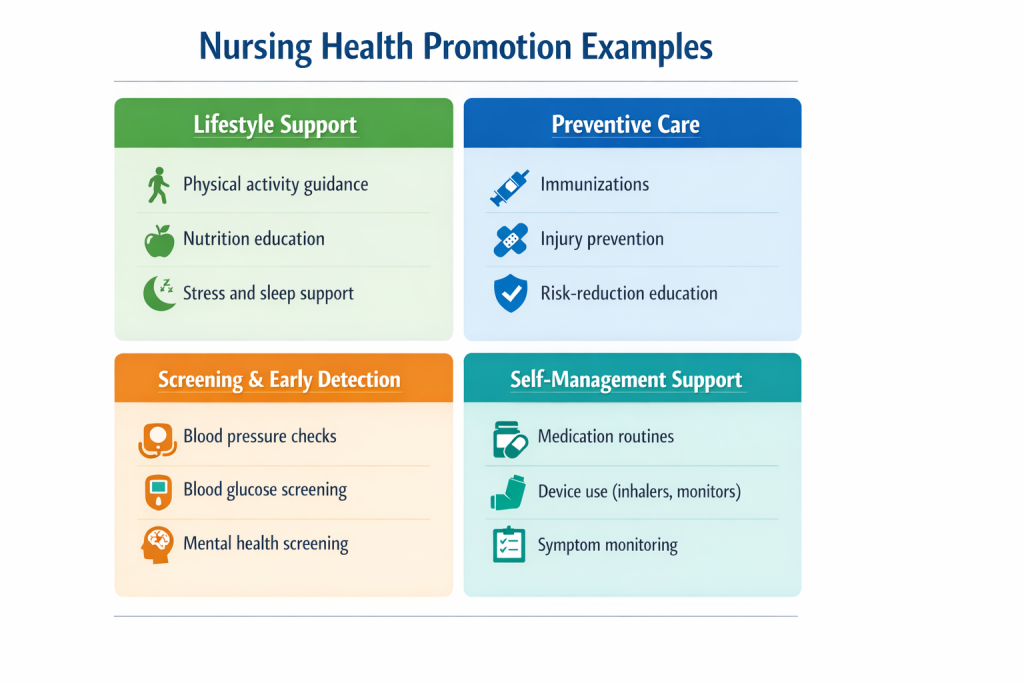
To avoid repetition and make examples easier to recognize, nursing health promotion activities can be grouped into four core categories. Each example below represents a distinct type of health promotion intervention.
Lifestyle and Behavior Support
These examples focus on helping patients adopt or maintain healthier daily habits.
- Encouraging regular physical activity to support cardiovascular health
- Educating patients on reducing sodium, sugar, or unhealthy fats
- Supporting smoking cessation through counseling and resources
- Reinforcing healthy sleep routines and stress management techniques
These interventions aim to reduce long-term health risks and support overall wellness.
Preventive Care and Risk Reduction
These examples focus on preventing illness or complications through awareness and early action.
- Explaining the importance of recommended vaccinations
- Teaching injury-prevention strategies such as fall prevention
- Reinforcing safe sexual practices to reduce infection risk
- Educating patients on recognizing early warning signs of illness
These actions help patients understand and reduce preventable health risks.
Screening and Early Identification
These examples support health promotion by increasing awareness and encouraging timely follow-up.
- Blood pressure and blood glucose screening education
- Mental health screening and discussion of results
- Teaching self-examination techniques when appropriate
- Reinforcing follow-up care after abnormal screening results
Screening becomes health promotion when patients understand the results and their role in prevention.
Self-Management and Skill Building
These examples focus on helping patients manage health conditions safely and independently.
- Teaching correct use of inhalers, monitors, or medical devices
- Reinforcing consistent medication routines
- Educating patients on symptom monitoring and response
- Supporting daily routines for chronic disease management
These interventions reduce complications and improve long-term outcomes.
Health Promotion Nursing Diagnosis Examples
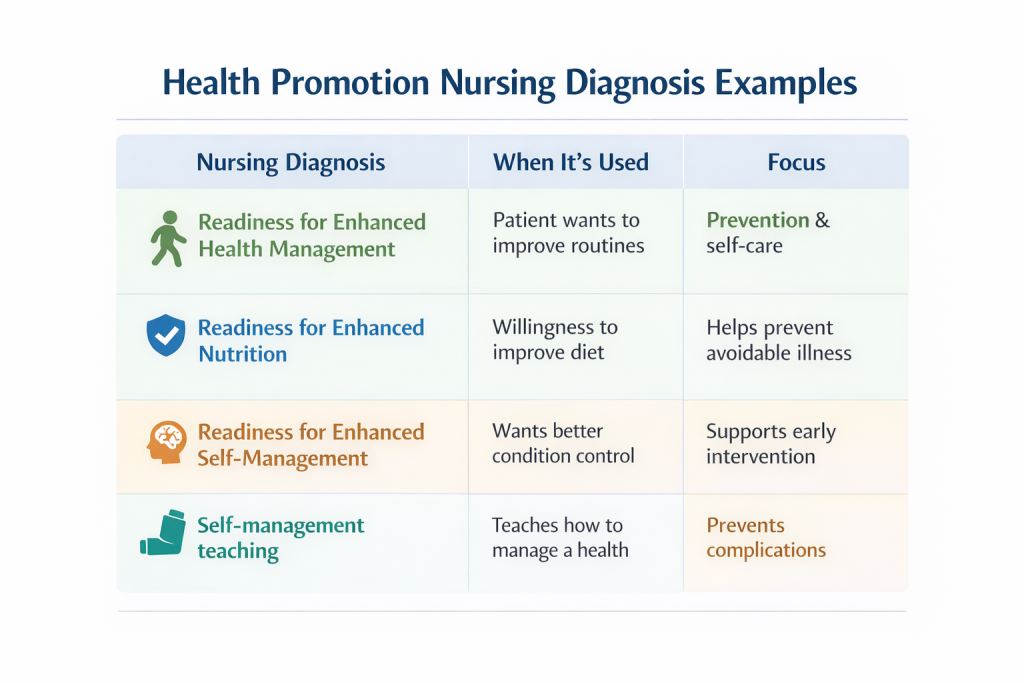
Health promotion nursing diagnoses are used when a patient shows readiness or motivation to improve health behaviors. These diagnoses focus on strengths, willingness to change, and prevention rather than on acute illness or deficits. They are commonly used in care plans, exams, and OSCEs to reflect proactive nursing care.
The most frequently used health promotion diagnoses include the following.
Readiness for Enhanced Health Management
This diagnosis applies when a patient expresses interest in improving how they manage their health, treatments, or daily routines. It is appropriate when the patient is stable but wants to improve consistency, understanding, or long-term outcomes.
This diagnosis is often used in situations involving chronic conditions, medication routines, lifestyle changes, or follow-up care. It reflects a patient’s willingness to take an active role in maintaining or improving health.
Readiness for Enhanced Nutrition
This diagnosis is used when a patient is willing to improve dietary habits to support health or manage a condition. It does not require the presence of malnutrition, only a desire to make healthier food choices.
It is commonly applied in patients with diabetes, hypertension, cardiovascular risk factors, or general wellness goals. The focus is on supporting realistic, sustainable nutrition changes rather than strict dietary rules.
Readiness for Enhanced Self-Management
This diagnosis fits patients who want to improve skills needed to manage a health condition safely. It applies when a patient shows interest in learning or strengthening skills such as medication use, symptom monitoring, or device management.
This diagnosis emphasizes independence and long-term safety, making it a strong choice for health promotion–focused care plans.
Linking Health Promotion Examples to Nursing Care Plans
One reason health promotion causes confusion is that it is often embedded within routine nursing care. In care plans, health promotion is identified by its purpose rather than by the task itself.
An intervention supports health promotion when it:
- reduces future health risks
- prevents complications
- strengthens patient self-care
- supports long-term health behaviors
For example, teaching medication timing is education, but reinforcing adherence to prevent complications is health promotion. Encouraging lifestyle changes to reduce future disease risk is health promotion even when no current illness is present.
Understanding this distinction helps students choose appropriate diagnoses and interventions during exams and clinical documentation.
Read more on patient education examples
Common Mistakes When Identifying Nursing Health Promotion Examples
A common mistake students make is assuming health promotion only occurs during formal teaching sessions. In reality, many health promotion activities happen during routine care, brief conversations, or follow-up discussions.
Another frequent error is labeling all patient education as health promotion. Education becomes health promotion when it supports prevention, reduces future risk, or helps patients manage their health more effectively over time. Teaching a task alone is not enough unless it connects to long-term outcomes.
Students also tend to associate health promotion only with patients who are ill. Health promotion applies just as much to maintaining wellness, preventing decline, and supporting healthy behaviors in individuals without diagnosed conditions.
Finally, health promotion should always match patient readiness. Using health promotion diagnoses or interventions without evidence that the patient is willing or motivated to change can lead to inaccurate care plans and weaker clinical reasoning.
Conclusion
Nursing health promotion focuses on prevention, risk reduction, and helping patients take an active role in their health. It is woven into everyday nursing practice and does not require lengthy instruction or complex planning.
By understanding health promotion strategies, recognizing clear examples, and using appropriate nursing diagnoses, students can confidently apply this concept in exams, care plans, and clinical settings. When nursing actions support healthier choices, prevent complications, or strengthen self-management, they meet the core purpose of health promotion in nursing.
FAQS
Why Is Health Promotion Important?
Health promotion is important because it addresses the root causes of many health problems rather than focusing only on treatment. Encouraging healthy behaviors, preventive care, and early intervention reduces the burden of chronic disease and improves overall quality of life.
At the population level, health promotion helps lower healthcare costs, reduce avoidable hospitalizations, and improve community health outcomes. At the individual level, it empowers people to take an active role in their own health decisions.
What Is the Health Promotion Model?
A health promotion model is a framework used to understand and guide behaviors that support health and wellness. These models help healthcare professionals identify factors that influence health choices and design interventions that encourage positive change.
Common health promotion models in nursing focus on concepts such as individual beliefs, motivation, perceived benefits, and environmental influences. They are used to guide patient education, behavior-change strategies, and preventive care planning.
In practice, health promotion models help nurses tailor interventions to a patient’s readiness, lifestyle, and support systems rather than using a one-size-fits-all approach.
