
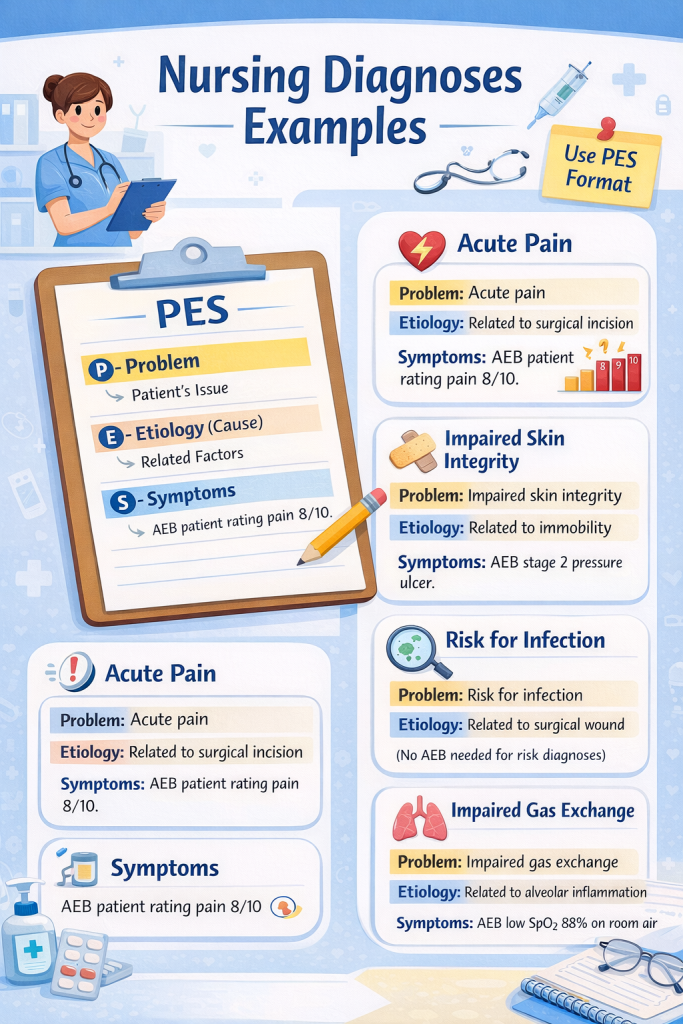
Writing a nursing diagnosis is a fundamental skill for nurses that bridges the gap between patient assessment and creating a clear, actionable care plan. Whether you’re a student just starting your nursing journey or a seasoned nurse looking to refine your diagnostic skills, understanding how to write accurate and effective nursing diagnoses is crucial.
In this guide, we’ll walk you through the step-by-step process of creating nursing diagnoses, explaining the PES format and how to apply it to real-life patient scenarios. You’ll also find common nursing diagnosis examples across different conditions and specialties, so you can feel confident in any clinical setting. By the end, you’ll have the tools to write nursing diagnoses that are not only clear and accurate but also aligned with best practices.
What Is a Nursing Diagnosis?
A nursing diagnosis is more than just a label. It’s a vital part of the nursing process that helps guide your care decisions. In simple terms, a nursing diagnosis is your clinical judgment about how a patient responds to a health condition. It’s the connection between gathering data through assessment and planning interventions that will improve patient outcomes.
But here’s where things get a little tricky: nursing diagnoses are different from medical diagnoses. While medical diagnoses focus on identifying and naming the disease or condition (think pneumonia or diabetes), nursing diagnoses describe the patient’s specific response to that condition and suggest ways to manage it.
Nursing Diagnosis vs. Medical Diagnosis
- Medical diagnosis: Pneumonia (identifying the disease)
- Nursing diagnosis: Ineffective airway clearance related to thick secretions AEB frequent coughing and coarse lung sounds (describing how the patient is responding to the disease)
This distinction is key because it shifts the focus from just treating the disease to improving the patient’s overall well-being through targeted interventions. Nurses don’t just treat the illness; they care for the person experiencing it.
NANDA-I Nursing Diagnosis Framework
When it comes to nursing diagnoses, there’s a helpful framework you’ll want to become familiar with: NANDA-I. This stands for the North American Nursing Diagnosis Association International, and it provides a standardized list of diagnoses that nurses use globally. Think of NANDA-I as the “dictionary” for nursing diagnoses. It’s the foundation upon which your diagnoses are built.
Understanding the NANDA-I framework helps ensure that your diagnoses are consistent and evidence-based, which in turn helps improve communication with other healthcare providers. It also ensures that your care plans are comprehensive and not just based on personal interpretation or vague assumptions.
How NANDA-I Organizes Nursing Diagnoses
NANDA-I groups nursing diagnoses into four major types, each focusing on different aspects of patient care. Knowing which type you’re working with is important because it determines how you’ll assess the patient’s condition and plan your interventions. Here’s a breakdown of each type:
Types of Nursing Diagnoses with Examples
a. Problem-Focused Nursing Diagnoses
These are the most common types of diagnoses you’ll encounter. A problem-focused nursing diagnosis describes an actual problem that the patient is experiencing right now. It’s based on data collected during the assessment phase, like physical signs, symptoms, and patient complaints.
Example 1: Acute pain related to surgical incision AEB facial grimacing and guarding
In this case, the patient is actively experiencing pain due to a recent surgical procedure. The nurse would plan interventions that aim to reduce pain and promote comfort.
Example 2: Impaired skin integrity related to pressure AEB reddened area on heel
Here, the patient has a pressure ulcer (often seen in immobile patients). The nurse would focus on wound care, repositioning, and preventing further skin breakdown.
b. Risk Nursing Diagnoses
Unlike problem-focused diagnoses, risk nursing diagnoses describe a potential problem the patient is at risk of developing. The key here is that the problem hasn’t occurred yet, but the patient is vulnerable based on certain factors.
Example 3: Risk for infection related to urinary catheter
The patient has a urinary catheter in place, which puts them at increased risk for a urinary tract infection (UTI). The nurse would focus on preventing infection through proper catheter care and hygiene.
Example 4: Risk for falls related to unsteady gait
This diagnosis indicates that the patient is at risk for falling due to difficulty walking or maintaining balance. The nurse would focus on fall prevention strategies, like providing assistance while walking and ensuring the environment is free of hazards.
c. Health Promotion Nursing Diagnoses
A health promotion nursing diagnosis focuses on a patient’s desire to improve their health, rather than addressing an existing problem. This type of diagnosis usually begins with “readiness to enhance” and is often based on patient motivation.
Example 5: Readiness to enhance nutrition AEB patient expressing interest in healthy meal planning
In this case, the patient is motivated to improve their diet. The nurse would support the patient by providing resources, education, and guidance on healthy eating habits.
d. Syndrome Nursing Diagnoses
Finally, a syndrome nursing diagnosis is used when multiple nursing diagnoses are grouped together under one label because they often occur together in certain conditions. These diagnoses are typically related to specific syndromes or conditions.
Example 6: Post-trauma syndrome AEB nightmares and flashbacks after accident
This diagnosis might be used for patients who have experienced a traumatic event, such as an accident. The nurse would focus on providing psychological support and helping the patient process the trauma.
Now that we’ve covered the main types of nursing diagnoses, it’s important to remember that these diagnoses are not just labels. They guide your actions as a nurse and ensure that you’re always focused on addressing the patient’s needs in a thoughtful and structured way.
The PES Format: How to Write a Nursing Diagnosis
Now that you understand the different types of nursing diagnoses, let’s talk about how to write them. Writing a nursing diagnosis might feel daunting at first, but once you get the hang of it, it becomes a formula that’s easy to apply.
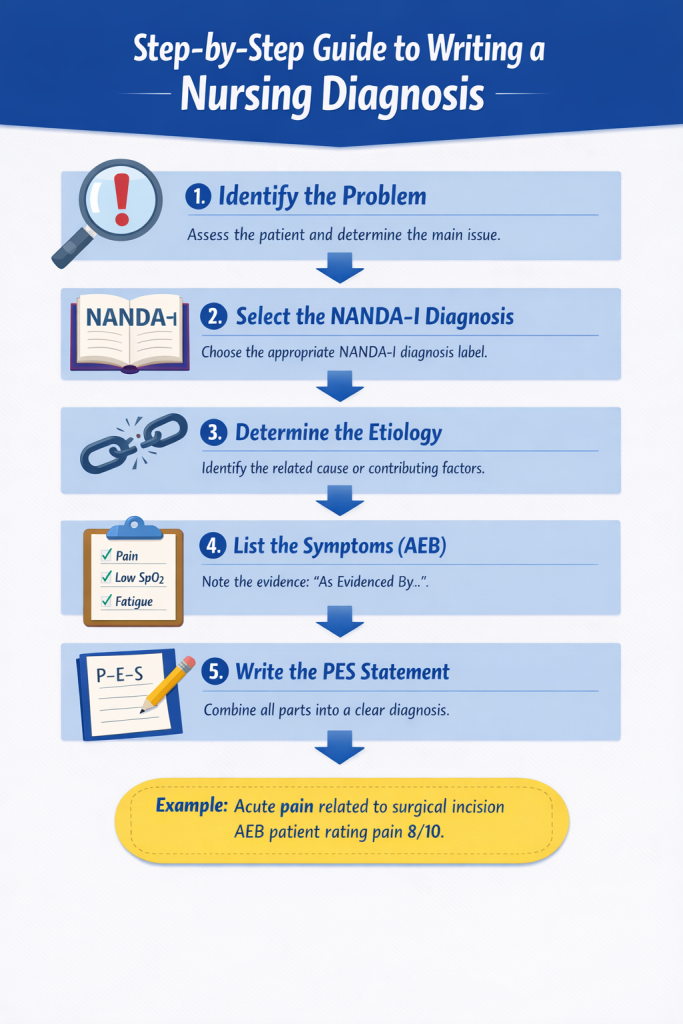
One of the most widely used structures is the PES format. It stands for Problem, Etiology, and Symptoms. Basically, the three key components you need to include in every nursing diagnosis.
Breaking Down the PES Format
- Problem (P): This is the nursing diagnosis label from NANDA-I, which represents the patient’s condition. For example, “Acute pain” or “Impaired mobility”.
- Etiology (E): This is the cause or related factor — the reason why the problem is occurring. It’s often linked to the patient’s disease or condition. For instance, “related to surgical incision” or “related to prolonged immobility”.
- Symptoms (S): These are the evidence or defining characteristics that show the problem exists. This part is often introduced with “as evidenced by (AEB)” and includes things like the patient’s reported symptoms, physical signs, or test results.
Example of a PES Statement:
Let’s look at a PES statement in action:
- Acute pain (P) related to tissue injury (E) AEB patient clutching abdomen and rating pain 9/10 (S)
This statement clearly describes:
- The problem: Acute pain
- The cause: Tissue injury (in this case, after surgery)
- The symptoms: The patient is clutching their abdomen and reporting significant pain (9/10)
It’s a structured way of identifying and documenting the patient’s condition, ensuring that your care plan is focused on both the cause and the evidence of the problem.
Common Nursing Diagnoses Examples for Practice
Having a solid grasp on how to structure a nursing diagnosis is important, but so is knowing the most common nursing diagnoses you’ll likely encounter in both classroom settings and clinical practice.
Here are a few examples of frequently used diagnoses for different types of conditions. These are your bread-and-butter diagnoses, ones you’ll probably use regularly.
a. Acute Pain
- Example: Acute pain related to surgical incision AEB facial grimacing and guarding.
- When to use: This diagnosis is common after surgeries or injuries where patients experience immediate pain.
- PES Format:
- Problem: Acute pain
- Etiology: Related to surgical incision
- Symptoms: AEB facial grimacing and guarding (the patient’s observable behavior indicating pain)
- Problem: Acute pain
b. Impaired Skin Integrity
- Example: Impaired skin integrity related to immobility AEB stage 2 pressure ulcer on sacrum.
- When to use: This is often seen in patients who are bedridden or have limited mobility.
- PES Format:
- Problem: Impaired skin integrity
- Etiology: Related to immobility
- Symptoms: AEB stage 2 pressure ulcer on sacrum (a visible wound on the skin)
- Problem: Impaired skin integrity
c. Risk for Infection
- Example: Risk for infection related to surgical wound and invasive devices.
- When to use: After surgeries or when patients have invasive medical devices like catheters or IVs.
- PES Format:
- Problem: Risk for infection
- Etiology: Related to surgical wound and invasive devices
- Symptoms: (Since this is a risk diagnosis, there is no evidence yet, only the possibility of infection)
- Problem: Risk for infection
d. Impaired Gas Exchange
- Example: Impaired gas exchange related to alveolar inflammation AEB SpO₂ 88% on room air.
- When to use: This diagnosis is commonly used in respiratory conditions like pneumonia or COPD.
- PES Format:
- Problem: Impaired gas exchange
- Etiology: Related to alveolar inflammation
- Symptoms: AEB SpO₂ 88% on room air (low oxygen saturation)
- Problem: Impaired gas exchange
e. Deficient Knowledge
- Example: Deficient knowledge related to new medication regimen AEB patient stating, “I don’t know when to take it.”
- When to use: This diagnosis can be applied when a patient is newly prescribed medication and doesn’t fully understand how to take it.
- PES Format:
- Problem: Deficient knowledge
- Etiology: Related to new medication regimen
- Symptoms: AEB patient asking repeated questions about when to take the medication
- Problem: Deficient knowledge
These are just a few examples, but they cover some of the most common scenarios you’ll face in both clinical settings and academic exams. By practicing these, you’ll build your confidence and refine your ability to write accurate and actionable nursing diagnoses.
Nursing Diagnoses Examples by Condition
As a nurse, you’ll often need to create nursing diagnoses based on specific health conditions. Some diagnoses are more common in certain diseases or conditions, so understanding these connections will help you develop effective care plans.
Here are nursing diagnoses examples for common conditions you may encounter in practice. These examples will give you a practical framework to adapt in various clinical settings.
a. Pneumonia nursing diagnosis examples
- Impaired gas exchange related to alveolar inflammation AEB dyspnea and hypoxemia.
- Ineffective airway clearance related to thick secretions AEB coarse lung sounds.
Pneumonia often leads to impaired lung function, so impaired gas exchange and ineffective airway clearance are common diagnoses. Nurses will focus on improving oxygenation, clearing secretions, and monitoring respiratory status.
b. Hypertension nursing diagnosis examples
- Risk for impaired tissue perfusion related to high blood pressure.
- Deficient knowledge related to blood pressure medication AEB patient stating, “I’m not sure when to take my pills.”
High blood pressure (hypertension) can compromise tissue perfusion, especially in vital organs like the brain and kidneys. You’ll often see risk for impaired tissue perfusion as a diagnosis. Additionally, deficient knowledge about managing hypertension through medication is also common.
c. COPD (Chronic Obstructive Pulmonary Disease) nursing diagnosis examples
- Impaired physical mobility related to shortness of breath and fatigue AEB patient unable to walk 10 feet without stopping.
- Ineffective breathing pattern related to bronchoconstriction AEB increased respiratory rate and use of accessory muscles.
Patients with COPD often face challenges with mobility due to fatigue and difficulty breathing. You’ll need to focus on improving breathing patterns and physical mobility, as well as educating patients on managing their condition.
d. Diabetes nursing diagnosis examples
- Risk for unstable blood glucose related to inconsistent diet.
- Deficient knowledge related to insulin therapy AEB incorrect self-administration.
Diabetes is often managed with medication and lifestyle adjustments, so you may need to address both nutritional needs and medication management in your nursing diagnosis. Risk for unstable blood glucose is a frequent concern, as is deficient knowledge about insulin administration.
e. Stroke (CVA) nursing diagnosis examples
- Impaired physical mobility related to left-sided weakness AEB difficulty walking.
- Risk for aspiration related to impaired swallowing AEB coughing during meals.
After a stroke, patients often face mobility issues and a risk for aspiration due to impaired swallowing. Nurses focus on assisting with mobility and ensuring safe eating practices to avoid aspiration.
Nursing Diagnoses Examples by Specialty
Each nursing specialty comes with its own set of common diagnoses that are particularly relevant to the population or clinical setting. Reviewing these specialty-specific diagnoses before clinical rotations or exams can help you prepare and gain confidence in these areas.
a. Pediatric Nursing
- Risk for dehydration related to persistent vomiting.
- Ineffective airway clearance related to asthma attack AEB wheezing and dyspnea.
In pediatric nursing, you’ll often encounter diagnoses like risk for dehydration in young patients with vomiting or diarrhea. Ineffective airway clearance is common in children with respiratory conditions like asthma, where nurses focus on improving breathing and managing symptoms.
b. Maternity Nursing
- Acute pain related to uterine contractions AEB patient verbalizing 9/10 pain.
- Risk for hemorrhage related to postpartum status.
Maternity nursing often involves managing acute pain during labor, and the risk of hemorrhage after childbirth. Nurses focus on pain relief during labor and monitoring for signs of hemorrhage in the postpartum period.
c. Psychiatric Nursing
- Anxiety related to hospitalization AEB restlessness and rapid speech.
- Risk for self-harm related to depressive thoughts.
Psychiatric nursing involves diagnoses related to mental health conditions. Anxiety and risk for self-harm are frequent in patients with severe mental health conditions. Nurses in this specialty work on providing emotional support and coping strategies to manage these conditions.
d. Geriatric Nursing
- Risk for falls related to impaired balance and unsteady gait.
- Confusion related to dementia AEB disorientation to time and place.
Geriatric nursing focuses on elderly patients, many of whom struggle with balance issues that increase the risk of falls. Confusion due to dementia is also common, requiring careful attention to safety and mental health.
e. Community Health Nursing
- Ineffective community coping related to lack of healthcare resources.
- Readiness for enhanced family processes AEB caregiver expressing desire for improved routines.
In community health nursing, nurses work with populations rather than individual patients. Ineffective community coping might occur in underserved areas with limited resources, while family processes may need improvement in communities facing challenges like poverty or social isolation.
These nursing diagnoses examples by condition and specialty provide you with a starting point to create accurate diagnoses based on a patient’s specific health issues. Understanding how these common diagnoses apply to different conditions will help you tailor your care plans effectively and improve patient outcomes.
Common Mistakes in Writing Nursing Diagnoses
Writing nursing diagnoses might seem straightforward, but it’s easy to slip up. Here are a few common mistakes that you’ll want to avoid when writing your diagnoses.
1. Using Medical Diagnoses Instead of Nursing Diagnoses
One of the most common mistakes is using a medical diagnosis when you should be writing a nursing diagnosis. While both are important, they serve different purposes:
- Medical diagnoses identify and name the disease or condition (e.g., pneumonia, diabetes).
- Nursing diagnoses describe the patient’s response to the disease or condition (e.g., Impaired gas exchange related to alveolar inflammation).
Mistake Example:
- Wrong: Pneumonia
- Right: Impaired gas exchange related to alveolar inflammation AEB SpO₂ 88% on room air.
By focusing on the patient’s response, you’ll provide care that is more holistic and patient-centered.
2. Forgetting “AEB” in a Problem-Focused Diagnosis
The “AEB” (as evidenced by) is essential for problem-focused diagnoses because it links the symptoms to the problem. This part is not necessary for risk diagnoses since the problem has not yet occurred.
Mistake Example:
- Wrong: Risk for falls related to unsteady gait AEB patient’s unsteady gait.
- Right: Risk for falls related to unsteady gait.
Tip: Always check your diagnosis to make sure you’re not mixing up problem-focused and risk diagnoses.
3. Being Too Vague or General
Another mistake is writing vague diagnoses that lack specific details. A general statement like “patient has breathing issues” doesn’t guide your care plan effectively. You need to get specific about the problem, cause, and symptoms.
Mistake Example:
- Wrong: Patient has breathing issues.
- Right: Impaired gas exchange related to alveolar changes AEB low oxygen saturation.
Specificity is key to creating targeted, actionable care plans.
4. Using the PES Format Incorrectly
The PES format is straightforward, but it’s important to get the correct order and appropriate details. Don’t skip over the etiology or use vague terms in place of the actual cause.
Mistake Example:
- Wrong: Acute pain AEB patient complaining of pain.
- Right: Acute pain related to surgical incision AEB patient reporting pain level 8/10 and guarding.
By following the PES format correctly, you ensure that your diagnosis is both accurate and complete.
Conclusion
Writing nursing diagnoses is more than just an academic exercise. It’s a tool that helps you provide better care for your patients. By understanding how to craft clear, accurate diagnoses using the PES format and NANDA-I framework, you can develop care plans that truly reflect the needs of the patient.
Remember, practice is key! The more you practice writing nursing diagnoses, the more natural it will become. With the examples, tips, and resources provided here, you’re well on your way to becoming a skilled diagnostician in your nursing practice.
Next Steps
- Practice writing nursing diagnoses for a variety of conditions and patient cases.
- Explore additional resources like care plan guides and nursing interventions to further develop your skills.
- Stay updated with the latest NANDA-I nursing diagnosis list to ensure your diagnoses reflect current standards.
FAQs on Nursing Diagnoses Examples
1. What’s the difference between risk and problem-focused diagnoses?
The key difference between risk and problem-focused diagnoses is that problem-focused diagnoses describe conditions that are already happening, whereas risk diagnoses highlight potential issues that may arise in the future.
- Problem-focused diagnosis: Impaired mobility related to muscle weakness AEB inability to walk 10 feet.
- Risk diagnosis: Risk for falls related to unsteady gait.
2. Do I need “as evidenced by” in every nursing diagnosis?
No, “as evidenced by” (AEB) is only used in problem-focused diagnoses. For risk diagnoses, you don’t need AEB because the problem has not yet occurred.
3. How often does NANDA-I update the nursing diagnosis list?
NANDA-I updates its list of diagnoses every three years. The latest edition (13th, 2024–2026) includes new and revised diagnoses, so it’s important to stay current.
4. Can students use pre-written nursing diagnoses in care plans?
Yes, students can use pre-written diagnoses as examples or templates, but it’s important to adapt them to the specific patient’s condition. Educators want to see critical thinking when students apply these diagnoses to real-life scenarios, not just copying and pasting.
