
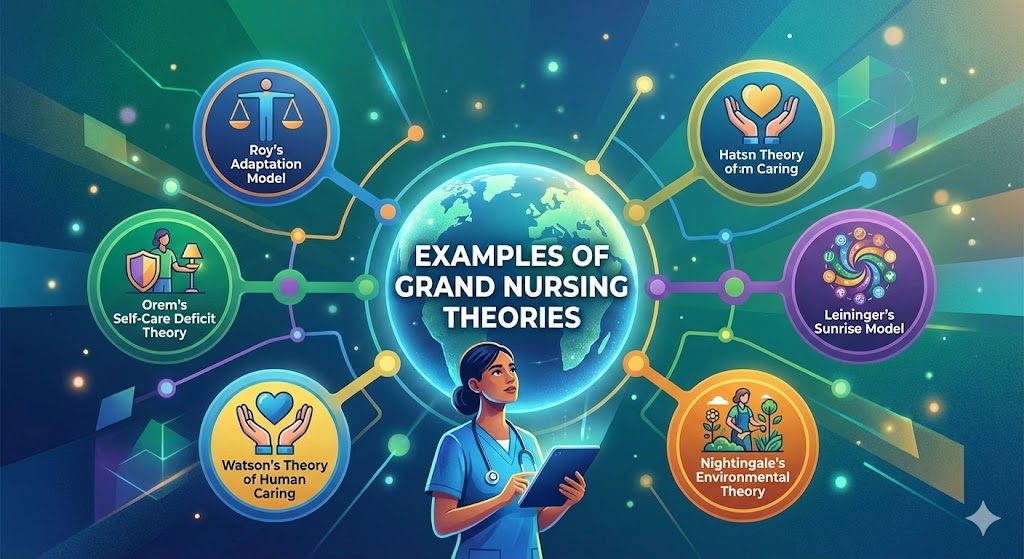
Grand nursing theories form the backbone of the nursing profession. They help nurses define what health means, how to interact with patients, and what there responsibilities look like across different cultures, eras, and healthcare environments. If you’re studying for an exam, writing an assignment, or simply trying to understand the bigger picture of nursing, reviewing examples of grand nursing theories is one of the best ways to see how these ideas guide real clinical practice.
In this guide, you’ll explore 20 examples of grand nursing theories, each explained in simple language with real-world applications. These theories may seem abstract at first, but they offer powerful ways to interpret patient experiences, make thoughtful decisions, and strengthen your nursing identity. By the end, you’ll understand how each theory influences the care you give every day.
What Are Grand Nursing Theories?
Grand nursing theories are the broadest and most conceptual frameworks in nursing. Think of them as the architectural “blueprint” for the entire discipline. They answer foundational questions such as:
- What is nursing?
- What is the nurse’s role?
- How do people, health, and the environment interact?
- What principles should guide our care?
Grand theories differ from middle-range and practice-level theories:
- Middle-range theories focus on specific issues (such as pain, stress, or cultural care).
- Practice-level theories provide direct, step-by-step guidance for specific clinical situations.
- Grand theories, however, set the foundation for all nursing practice by offering overarching worldviews that guide thinking, teaching, and research.
Most grand theories were created in the mid-20th century, during a period when nursing was carving out its identity as a distinct profession rather than an extension of medicine. Influential thinkers like Florence Nightingale, Sister Callista Roy, and Jean Watson built conceptual structures that still shape how nurses care, teach, and advocate today.
Before diving into the examples of grand nursing theories, it helps to know their key characteristics.
Characteristics of Grand Nursing Theories
You can usually recognize a grand theory by the following traits:
1. Broad Scope
They apply to all patients, in all situations—whether you work in a rural clinic or a major teaching hospital.
2. Meta-Paradigm Focus
Grand theories explore the relationships among the four foundational concepts of nursing:
Person, Health, Environment, and Nursing.
3. High Level of Abstraction
They are not procedural checklists. They are big-picture ideas that require interpretation and critical thinking.
4. Holistic Orientation
Grand theories emphasize the whole person—physical, emotional, social, environmental, and sometimes spiritual dimensions.
5. Foundational Role
They give nursing its conceptual identity, guiding everything from curriculum design to policy development.
In short: grand theories provide the intellectual framework that underpins the entire profession. They don’t tell you what to do—they help you understand why and how you care.
Now that you understand what defines a grand nursing theory and the characteristics that make these frameworks so influential, it becomes much easier to see how they shape real nursing practice. To bring these ideas to life, the next section walks through examples of grand nursing theories that have guided education, research, and patient care for decades. Each theory offers a unique way of seeing the nurse–patient relationship, the meaning of health, and the forces that influence healing. By reviewing these examples one by one, you’ll gain a clearer picture of how abstract concepts translate into practical, day-to-day decision-making at the bedside.
20 Examples of Grand Nursing Theories
1. Florence Nightingale – Environmental Theory
Florence Nightingale believed that the environment surrounding a patient has a direct impact on healing. She saw the nurse’s primary role as improving environmental conditions to support the body’s natural ability to recover.
Key Concepts
- Clean, well-ventilated air
- Access to pure water
- Adequate lighting (especially natural light)
- Effective waste and sanitation systems
- Quiet, orderly surroundings
Example:
In a surgical recovery unit, nurses still use Nightingale’s principles. They keep the room clean and calm, maintain sterile wound environments, adjust lighting to promote rest, and educate families on maintaining a clean and safe home environment after discharge.
2. Dorothea Orem – Self-Care Deficit Nursing Theory
Orem believed that nursing becomes necessary when individuals cannot meet their own self-care needs. The nurse’s role is to assess the gap and support the patient’s return to independence.
Key Concepts
- Self-Care: Daily activities individuals perform to maintain health.
- Self-Care Deficit: A mismatch between what a person needs and what they can do.
- Nursing Systems:
- Wholly compensatory (nurse does all care)
- Partially compensatory
- Supportive-educative (nurse teaches and guides)
- Wholly compensatory (nurse does all care)
Example:
A stroke patient may initially require full assistance with bathing, feeding, and medication. Over time, the nurse transitions into a coaching role, teaching adaptive techniques—such as dressing with one hand—to help the patient regain independence.
3. Sister Callista Roy – Adaptation Model
Roy viewed people as adaptive systems who respond to internal and external stressors. Health is the ability to adapt effectively.
Key Concepts
Roy identified four adaptive modes:
- Physiological–Physical: bodily functions
- Self-Concept–Group Identity: personal feelings and self-image
- Role Function: expected social roles
- Interdependence: relationships and support systems
Example:
A patient recovering from an amputation requires multifaceted care: wound management (physiological), body-image support (self-concept), assistance planning return to work (role function), and connection to support groups (interdependence).
4. Martha Rogers – Science of Unitary Human Beings
Rogers viewed humans as irreducible, energy-based beings who exist in constant interaction with their environment. Health is an expression of the harmonious flow of these energy fields.
Key Concepts
- Humans and environments contain interconnected energy fields
- Health reflects rhythm, pattern, and harmony
- Nursing interventions should promote balance and well-being
Example:
In hospice care, nurses often use comfort-enhancing strategies such as soft lighting, aromatherapy, and calming music. These interventions help regulate the environment and promote peace, aligning with Rogers’ view of holistic energy balance.
5. Jean Watson – Theory of Human Caring
Watson argued that caring—not just clinical skill—is the foundation of nursing. Her theory emphasizes deep, authentic human-to-human relationships that promote healing.
Key Concepts
- Carative (caritas) processes
- Kindness, compassion, and presence
- Respect for the patient’s feelings and dignity
- Creation of a healing emotional and physical environment
Example:
An oncology nurse practicing Watson’s theory might sit with a patient during chemotherapy, listen to their concerns, and offer emotional support. The human bond helps ease suffering even as medical treatment addresses the disease.
6. Imogene King – Theory of Goal Attainment
King viewed nursing as a collaborative process in which the nurse and patient work together to set goals and achieve positive outcomes.
Key Concepts
- Personal System: individual perception, self-growth
- Interpersonal System: communication and interaction
- Social System: the wider context (family, community, healthcare system)
Example:
With a newly diagnosed diabetic patient, the nurse collaborates to set realistic goals—such as walking daily or reducing sugary drinks. Shared goal-setting increases motivation and adherence to treatment.
7. Betty Neuman – Neuman Systems Model
Neuman conceptualized patients as open systems constantly affected by internal and external stressors. Nursing aims to strengthen the patient’s defenses to maintain stability.
Key Concepts
- Stressors: environmental, psychological, physiological
- Lines of Defense: protective factors that maintain balance
- Three Levels of Intervention:
- Primary: prevent stressors
- Secondary: treat symptoms early
- Tertiary: support recovery and rehabilitation
- Primary: prevent stressors
Example:
For a patient with heart failure, a nurse emphasizes prevention (primary intervention) by monitoring diet, daily weight, and stress. This reduces symptom flare-ups and prevents readmission.
8. Madeleine Leininger – Culture Care Diversity and Universality Theory
Leininger recognized that people’s cultural backgrounds shape the way they understand health, illness, healing, and care. She founded transcultural nursing to ensure that care is meaningful and culturally respectful.
Key Concepts
Leininger believed nurses must provide culturally congruent care through three modes:
- Culture Care Preservation: Supporting beneficial cultural practices.
- Culture Care Accommodation: Adjusting care to fit cultural needs.
- Culture Care Repatterning: Helping patients modify harmful practices in culturally sensitive ways.
Example:
For a Muslim patient observing Ramadan, a culturally sensitive nurse avoids forcing a standard meal schedule. Instead, they adjust medication times and ensure halal food options, allowing the patient to maintain their religious practices while staying safe.
9. Myra Levine – Conservation Model
Levine believed the goal of nursing is to help patients conserve their energy and integrity so they can heal more effectively. Her model focuses on supporting patients while minimizing unnecessary physical or emotional stress.
Key Concepts
Levine described four areas of conservation:
- Energy Conservation: Reducing fatigue and promoting rest.
- Structural Integrity: Protecting and healing the body.
- Personal Integrity: Respecting identity, dignity, and individuality.
- Social Integrity: Supporting meaningful relationships and social roles.
Example:
For a patient with COPD, a nurse spaces out daily activities to prevent exhaustion, uses assistive devices to reduce effort, and supports the patient’s self-esteem and relationships. This preserves energy and promotes more effective healing.
10. Hildegard Peplau – Interpersonal Relations Theory
Peplau viewed nursing as a therapeutic relationship that evolves in stages. She emphasized communication, trust, and emotional support as essential components of healing.
Key Concepts
Peplau described three phases of the nurse–patient relationship:
- Orientation: Establish trust, identify needs, and set expectations.
- Working: Collaborate to address problems and build coping skills.
- Termination: Conclude the relationship once goals are met.
Example:
A mental health nurse caring for a patient with anxiety begins by developing rapport, then teaches coping strategies during the working phase. When the patient demonstrates improved functioning, the relationship moves toward a healthy, supportive termination.
11. Lydia Hall – Care, Core, and Cure Theory
Hall proposed that nursing has three interconnected components—care, core, and cure—which work together to support holistic healing.
Key Concepts
- Care: Hands-on, nurturing activities such as hygiene and comfort.
- Core: The patient’s internal world—goals, feelings, and emotional needs.
- Cure: Medical interventions and treatments directed by healthcare providers.
Example:
In stroke rehabilitation, a nurse integrates all three domains: providing physical support and hygiene (Care), helping the patient process emotions and adjust to new limitations (Core), and supporting prescribed therapies and medication plans (Cure).
12. Faye Abdellah – 21 Nursing Problems Theory
Abdellah shifted nursing from a disease-centered model to a patient-centered framework. She identified 21 patient problems that guide assessment and care.
Key Concepts
- Nursing involves problem-solving based on identified patient needs.
- The 21 problems cover physical, emotional, and social dimensions.
- Nurses must use critical thinking to select appropriate interventions.
Example:
Caring for a post-surgical patient, the nurse evaluates multiple areas: pain, ambulation, nutrition, safety, emotional distress, and more. Using Abdellah’s framework ensures no aspect of the patient’s well-being is overlooked.
13. Ernestine Wiedenbach – The Helping Art of Clinical Nursing
Wiedenbach believed nursing is fundamentally a helping art. A nurse must identify a patient’s immediate need for help and use skilled judgment and compassion to meet that need.
Key Concepts
- Clear observation of patient behavior
- Accurate interpretation of what the behavior means
- Purposeful actions that meet the patient’s specific need
- Use of one’s personality as a therapeutic tool
Example:
During labor, a nurse responds moment-to-moment to the mother’s needs—offering physical comfort, emotional reassurance, and breathing coaching. The nurse’s presence and awareness directly influence the patient’s sense of safety and strength.
14. Ida Jean Orlando – Nursing Process Theory
Orlando argued that effective nursing begins with observing patient behavior and responding therapeutically. She emphasized that nurses should never act automatically; they must always validate the patient’s needs.
Key Concepts
- Patient behavior is a call for help—either verbal or nonverbal.
- The nurse must assess the behavior, explore its meaning, and intervene thoughtfully.
- Reflexive or assumption-based actions can harm rather than help.
Example:
If a postoperative patient is restless or grimacing, the nurse immediately investigates: Is it pain? Nausea? Anxiety? Orlando’s model prevents delay by prompting immediate reassessment and timely intervention.
15. Margaret Newman – Health as Expanding Consciousness Theory
Newman viewed health and illness as part of the same evolving process. Illness is not simply a breakdown, but an opportunity for individuals to gain deeper insight, awareness, and meaning.
Key Concepts
- Health is a pattern of expanding consciousness, not merely the absence of disease.
- Individuals grow through experiences of disruption or illness.
- Nurses support patients by helping them recognize patterns, find meaning, and strengthen personal awareness.
Example:
An oncology nurse applies Newman’s theory by encouraging patients to reflect on their relationships, priorities, and personal goals throughout chemotherapy. The nurse helps the patient identify meaning and purpose, guiding them toward emotional and spiritual growth even in the midst of illness.
16. Rosemarie Parse – Human Becoming Theory
Parse believed nursing is not about fixing or controlling patients, but about supporting individuals as they choose their own paths. Quality of life is defined by the patient, not the nurse.
Key Concepts
- Nurses must honor the patient’s personal values and life choices.
- Presence, listening, and respect guide the nurse–patient relationship.
- Health is the way a person lives their experiences, not a clinical outcome alone.
Example:
In palliative care, a patient may decline aggressive treatments to spend meaningful time at home. A nurse using Parse’s theory honors this choice, organizes supportive resources, and focuses on comfort and dignity according to the patient’s values.
17. Katharine Kolcaba – Comfort Theory
Kolcaba defined comfort as a measurable outcome that nursing can intentionally enhance. Comfort includes relief, ease, and transcendence across physical, psychological, social, and environmental domains.
Key Concepts
- Relief: Meeting a specific need (e.g., pain medication).
- Ease: Promoting calm and contentment.
- Transcendence: Helping patients rise above their challenges.
- Comfort can occur in four contexts: physical, psychospiritual, sociocultural, and environmental.
Example:
In an ICU, a nurse promotes comfort by warming blankets, dimming lights, explaining procedures clearly, coordinating family support, and reducing environmental stress. These interventions lower anxiety and allow the body to heal more effectively.
18. Boykin & Schoenhofer – Theory of Nursing as Caring
Boykin and Schoenhofer believed that caring is not just something nurses do — it is the essence of who nurses are. Every interaction, no matter how small, expresses caring.
Key Concepts
- Each person is a unique, whole individual deserving of genuine presence.
- Caring is a mutual relationship that affirms both nurse and patient.
- The nurse’s role is to nurture caring moments that honor the personhood of the patient.
Example:
A pediatric nurse kneels to meet a frightened child at eye level, uses simple language to explain a procedure, and offers a comfort object. This recognizes the child not simply as a patient, but as a whole person with fears, preferences, and individuality.
19. Erickson, Tomlin & Swain – Modeling and Role-Modeling Theory
This theory emphasizes understanding the patient’s worldview before planning care. Nurses “model” the patient’s perspective, then create interventions that “role-model” the ideal behaviors or strategies that fit that worldview.
Key Concepts
- Modeling: Understanding the patient’s beliefs, experiences, and meaning.
- Role-Modeling: Designing care that supports growth in a way that aligns with the patient’s values and coping style.
- Healing requires respecting personal uniqueness.
Example:
A patient with PTSD may feel overwhelmed by traditional talk therapy. A nurse using this theory recognizes the patient’s fear (modeling) and introduces grounding exercises or sensory-based interventions instead of forcing a standard approach (role-modeling).
20. Afaf Meleis – Transitions Theory
Meleis focused on transitions—major life changes that can cause vulnerability. Nurses play a central role in supporting individuals through these shifts.
Key Concepts
- Transitions may be developmental (parenthood), situational (retirement), or health-related (hospitalization).
- Successful transitions require preparation, knowledge, and support.
- Nurses bridge gaps by offering guidance, education, and resources.
Example:
A community health nurse supporting a new mother provides education on infant care, emotional reassurance, and referrals to community groups. The goal is to help the mother feel capable, informed, and supported during the demanding transition into parenthood.
Conclusion
Studying these examples of grand nursing theories reveals how deeply they continue to shape nursing practice. Although each theory approaches health and healing from a different angle, they all offer valuable insight into how nurses think, respond, and build meaningful relationships with patients. From Nightingale’s environmental principles to Meleis’s transition-focused framework, grand theories help us understand the purpose behind our actions—not just the tasks we perform.
Whether you are preparing for a test or caring for patients on the floor, these examples of grand nursing theories give you a structured way to interpret complex situations and support the whole person. They remind us that nursing is both a science and an art, grounded in compassion, critical thinking, and a clear professional identity. By carrying these theories with you, you strengthen your ability to provide thoughtful, intentional, and truly impactful care.
Frequently Asked Questions
1. What are grand nursing theories?
Grand nursing theories are broad, abstract frameworks that explain the overall nature and purpose of nursing. They explore big ideas such as the meaning of health, the nurse–patient relationship, and how people interact with their environment. These theories provide the foundation for all levels of nursing practice.
2. What are the best examples of grand nursing theories?
Common examples of grand nursing theories include Florence Nightingale’s Environmental Theory, Dorothea Orem’s Self-Care Deficit Theory, Sister Callista Roy’s Adaptation Model, Martha Rogers’s Science of Unitary Human Beings, Jean Watson’s Theory of Human Caring, Imogene King’s Goal Attainment Theory, and Betty Neuman’s Systems Model.
3. How are grand nursing theories different from middle-range theories?
Grand theories are highly abstract and focus on the broad nature of nursing, while middle-range theories are more specific and address particular concepts such as pain, stress, or cultural care. Middle-range theories are easier to test and apply directly to research or clinical situations.
4. Why do nursing students study examples of grand nursing theories?
Students study these theories to understand the philosophical foundation of nursing. Reviewing examples of grand nursing theories helps learners see how nursing developed, how different theorists shaped the profession, and how these ideas influence care, decision-making, and communication in real practice.
5. Is Jean Watson’s Theory of Human Caring a grand nursing theory?
Yes. Watson’s Theory of Human Caring is considered a grand nursing theory because it offers a broad, holistic framework for understanding compassion, healing, and human connection in nursing practice.
6. Is Orem’s Self-Care Deficit Theory a grand nursing theory?
Yes. Dorothea Orem’s Self-Care Deficit Theory is classified as a grand nursing theory because it provides a wide-reaching explanation of when nursing is needed and how nurses support patients in regaining independence.
7. Do I need to memorize all examples of grand nursing theories for exams?
Most nursing programs expect students to know the major theorists (such as Nightingale, Orem, Roy, and Watson) and understand the basic purpose of each theory. Memorizing all examples of grand nursing theories is helpful, but the most important part is knowing the central idea and how each theory applies to patient care.
8. How do grand nursing theories influence everyday nursing practice?
Although grand theories are broad, they shape the values, decisions, and approaches nurses use every day. They guide how nurses view patients, define health, communicate, provide comfort, adapt to change, and create healing environments.
9. Can grand nursing theories help with clinical decision-making?
Yes. Grand nursing theories provide a conceptual lens that helps nurses interpret patient behavior, identify needs, and choose interventions that align with holistic care. They enhance critical thinking by connecting practical actions to deeper professional principles.
10. What is the easiest way to study examples of grand nursing theories?
Break them into small categories:
- Who created the theory
- The Core Idea
- Key concepts
- One real-world example
This structure makes theories easier to remember and apply in exams or assignments.
