
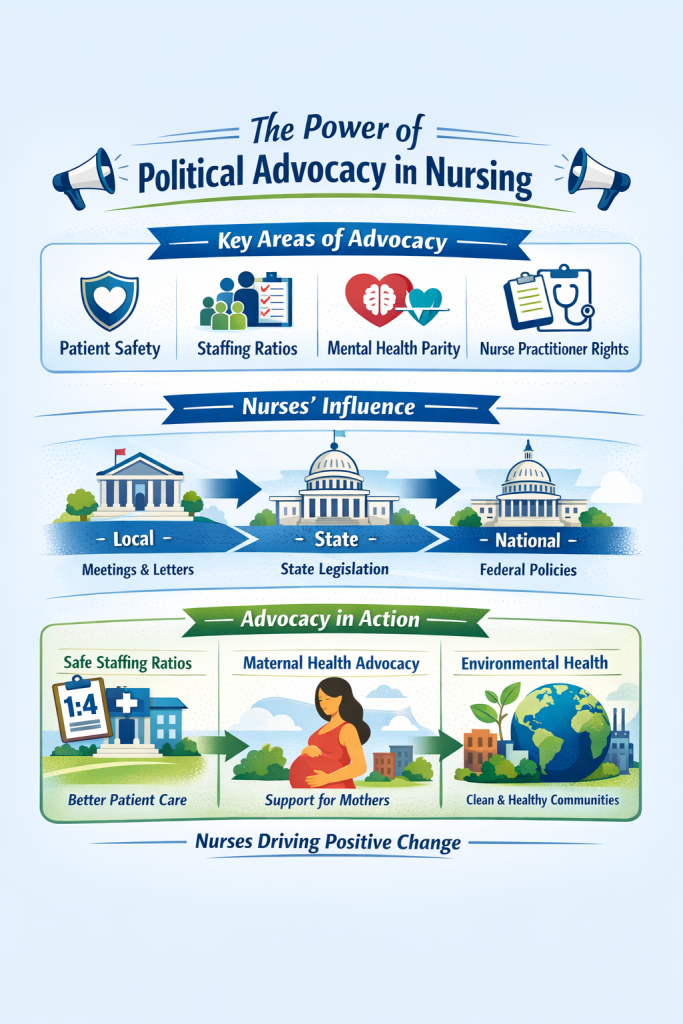
Have you ever wondered how nurses create change beyond the bedside? That’s where political advocacy comes in, transforming nursing expertise into action that shapes healthcare policies and systems.
In nursing, political advocacy means using your professional voice to influence decisions that affect patients and providers alike. It’s about ensuring that legislation reflects the realities of healthcare, not just theoretical policies. Whether advocating for safe staffing ratios, better mental health funding, or fair pay, nurses can shape policies that protect both patients and their profession.
In this guide, you’ll explore powerful examples of political advocacy in nursing and learn how you can make a difference no matter where you work or study.
Understanding Political Advocacy in Nursing
What Is Political Advocacy?
Political advocacy in nursing is about more than just voicing concerns, it’s about taking action to shape the policies and systems that affect healthcare. It’s about turning everyday experiences into lasting change. From writing letters to legislators to testifying at hearings, political advocacy is how nurses influence the decisions that impact their patients and their profession.
It isn’t about party lines or political debates. It’s about using the collective voice of the nursing profession to push for changes that improve patient care, make work environments safer, and ensure nurses have the tools they need to provide the best care possible. Whether it’s advocating for safe staffing ratios or pushing for expanded access to mental health care, political advocacy is a way for nurses to make a real impact on a larger scale.
At its core, political advocacy in nursing is about fixing the systems behind the issues. While patient advocacy focuses on individuals, political advocacy tackles the broader challenges making sure healthcare policies work for everyone.
Why Political Advocacy Is Integral to Nursing Practice
- Nurses are trusted professionals: As the largest group of healthcare providers, nurses are trusted by patients and the public. This trust gives us the power to advocate for meaningful change.
- Policies affect everything: From staffing ratios to pay and patient safety, policies influence every part of nursing practice. By being involved, nurses ensure that policies reflect the realities of healthcare.
- Advocacy aligns with nursing ethics: The ANA Code of Ethics (Provision 9) emphasizes the responsibility to advocate for social justice. Nurses are called to ensure that healthcare policies are fair and just, benefiting everyone not just a few.
- It’s a way to protect patients and the profession: When nurses speak up, we ensure that patient needs are prioritized, and our working conditions are improved. Advocacy helps shape a healthcare system that supports both patients and the professionals caring for them.
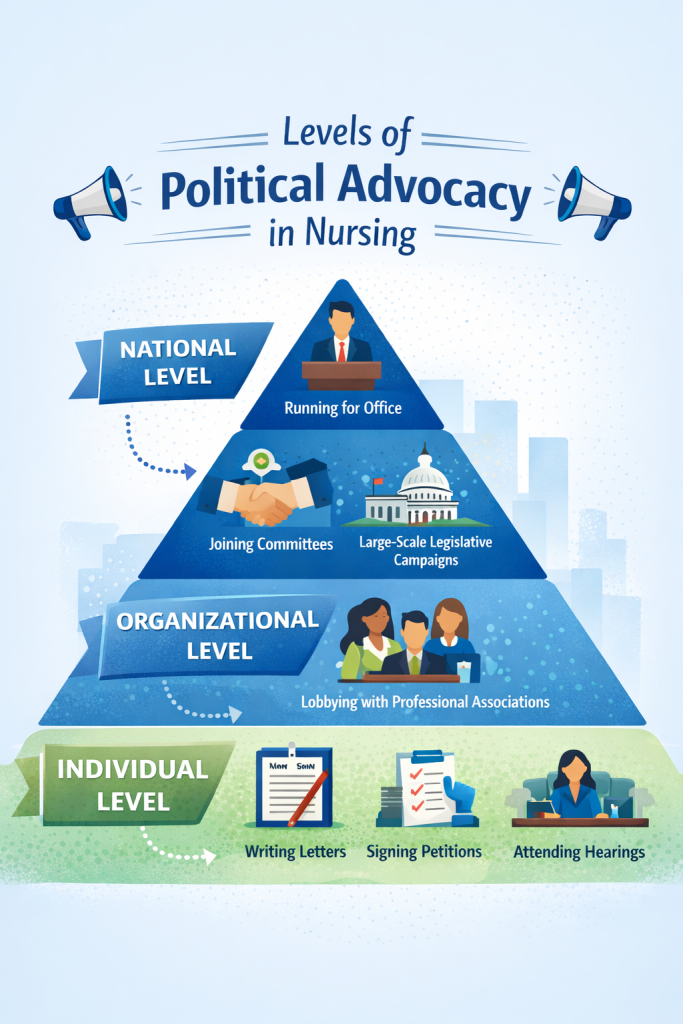
Levels of Political Advocacy in Nursing
Political advocacy can happen at different levels, and every level matters:
- Individual Level:
- Write letters to legislators, sign petitions, or speak at local health hearings.
- Every voice counts, and even a single email can spark change.
- Write letters to legislators, sign petitions, or speak at local health hearings.
- Organizational Level:
- Join hospital policy committees or professional associations that influence local regulations.
- Being part of these groups gives nurses the platform to influence decisions within their workplaces.
- Join hospital policy committees or professional associations that influence local regulations.
- National Level:
- Support legislative campaigns, participate in policy boards, or even run for office.
- National advocacy can lead to large-scale changes that impact healthcare on a broader scale.
- Support legislative campaigns, participate in policy boards, or even run for office.
Every nurse, whether a student or a seasoned professional, can find a place in advocacy. Sometimes, it starts with a single action like a letter, a petition, or even just showing up.
Real-World Examples of Political Advocacy in Nursing
Political advocacy comes to life when nurses turn concern into action. A safety issue, a late-night frustration, or a patient’s story can grow into a law or national campaign. Here are powerful examples of how nurses shape health policy every day:
1. Legislative Advocacy for Safe and Fair Practice
Safe Staffing Ratio Campaigns
Nurses everywhere fight for safe staffing ratio laws that limit how many patients one nurse can handle.
- Example: California’s Safe Staffing Law (AB 394) — the first law in the U.S. to set nurse-to-patient ratios.
- Impact: Fewer patient deaths, reduced nurse burnout.
- Lesson: Change starts with data, teamwork, and persistence.
Scope-of-Practice Expansion
Nurse practitioners (NPs) have long fought for the ability to diagnose, treat, and prescribe independently.
- Example: In Arizona and New Mexico, nurses helped pass laws granting full practice authority.
- Impact: More access to affordable primary care, especially in underserved areas.
2. Whistleblower and Patient Rights Protections
Whistleblower Protections
When nurses report unsafe conditions, they must be protected from retaliation.
- Example: The ANA pushed for amendments to the Patient Safety and Quality Improvement Act, ensuring whistleblowers’ job security.
- Impact: Safer hospitals and greater accountability across healthcare systems.
3. Federal Health Policy Campaigns Led by Nurses
Improving Care and Access to Nurses (ICAN) Act
- Example: ICAN Act removes Medicare and Medicaid barriers for advanced practice nurses.
- Advocacy Actions: Writing letters to Congress, hosting “Virtual Hill Days,” sharing testimony in hearings.
- Impact: More access to preventive care, especially for older adults and rural communities.
Maternal Health and Equity Initiatives
- Example: Black Maternal Health “Momnibus” Act, which addresses racial disparities in maternal care.
- Impact: Increased federal funding for community-based maternal programs.
4. Advocacy for Mental Health Policy
Mental Health Parity Advocacy
- Example: The American Psychiatric Nurses Association (APNA) lobbied for updates to the Mental Health Parity Act, ensuring equal insurance coverage for mental health services.
- Impact: Equal access to psychiatric care and therapy.
5. Advocacy for Health Equity and Social Determinants
Environmental & Climate Health
- Example: Nurses from the Alliance of Nurses for Healthy Environments (ANHE) advocated for clean-air laws.
- Impact: Healthier air and increased community awareness of pollution’s risks.
Voting and Civic Engagement
- Example: The “Nurses Vote” program helps register voters inside clinics and hospitals.
- Impact: Increased participation from healthcare workers and patients, boosting attention to health-related policies.
6. Immigration and Patient Rights
Sanctuary Policies for Hospitals
- Example: Advocacy groups pushed for policies that protect patients from immigration enforcement in hospitals.
- Impact: Patients now receive care without fear of deportation or discrimination.
7. Nurses in Leadership and Policy Roles
Nurses in Public Office
- Example: Rep. Lauren Underwood, RN — one of the youngest Black women in Congress — uses her healthcare background to guide health equity legislation.
- Impact: Shaping national policy with real healthcare experience.
Nurses on Policy Boards
- Example: Nurses serve on state health boards, hospital councils, and WHO committees.
- Impact: Ensures policies are rooted in clinical reality, not just theory.
8. Global Advocacy
International Council of Nurses (ICN)
- Example: ICN advocates for fair pay, safe workplaces, and gender equity on a global scale.
- Impact: Nurses’ perspectives help shape global health goals.
9. Collective Advocacy Through Professional Organizations
American Nurses Association (ANA)
- Advocacy Actions: Lobbies for safe staffing, workplace safety, and nurse education funding.
- Resources: Provides an Advocacy Toolkit with scripts and templates.
American Association of Critical-Care Nurses (AACN)
- Advocacy Actions: Promotes healthy work environments and safety standards.
- Resources: Members testify about workplace violence in state legislatures.
American Psychiatric Nurses Association (APNA)
- Advocacy Actions: Pushes for mental-health parity and anti-stigma laws.
- Resources: Shares policy briefs and advocacy guides.
How Nurses Can Get Involved in Political Advocacy
You don’t need to be a policy expert to make a difference. Advocacy starts with awareness realizing your daily experiences are evidence that can change policy.
Beginner-Friendly Ways to Participate
If you’re new to advocacy, start small:
- Join a professional organization. ANA and state associations send alerts and action guides.
- Subscribe to health-policy updates. Know what bills are coming before they pass.
- Contact your representatives. A single letter or call can influence a vote.
- Use social media wisely. Share reliable health-policy posts and tag nursing groups.
- Attend local health-board meetings. See how decisions are made in your own community.
Pro tip: Set one day a month for advocacy. Consistency matters more than time.
Intermediate & Leadership Pathways
Once you’re comfortable, expand your reach:
- Join a policy or ethics committee at work.
- Collaborate with coalitions such as ANHE or Nurses for America.
- Write op-eds or blog posts about healthcare issues.
- Mentor nursing students interested in policy work.
- Attend “Nurses Day at the Capitol” to see advocacy in action.
Every step builds your confidence, visibility, and influence.
Barriers to Nurse Political Participation
Even the most passionate nurses face challenges when it comes to advocacy. Recognizing these barriers helps you plan realistic and lasting ways to stay involved.
Common Obstacles
- Time constraints: Long shifts and fatigue make it hard to attend meetings or track new laws.
- Limited knowledge: Many nurses feel unsure about how policy or legislation works.
- Workplace culture: Some employers discourage political involvement or see it as “off-duty.”
- Fear of consequences: Worry about being seen as outspoken or controversial.
- Lack of mentorship: Few role models to show how advocacy actually works in practice.
It’s easy to think advocacy is only for senior nurses or administrators but that’s a myth. Many strong advocates started with no policy experience at all.
Strategies to Overcome Barriers
The good news? Every challenge has a workaround.
- Start small. One tweet, one letter, or one petition can raise awareness.
- Learn as you go. Many nursing associations offer free mini-courses or webinars on advocacy basics.
- Find a mentor. Ask within your workplace or state chapter who’s involved in advocacy most are happy to guide you.
- Team up. Join with coworkers to write letters or attend events together. Advocacy feels easier when shared.
- Build workplace support. Frame advocacy as part of professional growth and patient safety.
- Use downtime wisely. Listen to policy podcasts or read quick newsletters during commutes or breaks.
When advocacy becomes part of your identity, it stops feeling like extra work and starts feeling like purpose.
Impact of Political Advocacy in Nursing and Public Health
When nurses raise their voices, change follows. Advocacy doesn’t just rewrite laws, it improves care, empowers professionals, and builds healthier communities.
Tangible Policy Outcomes
| Policy Area | Advocacy Result | Nursing & Public Benefit |
| Safe staffing ratios | State laws mandating nurse-patient ratios | Fewer errors, less burnout, safer hospitals |
| APRN practice authority | Independent practice for advanced nurses | Easier access to care, especially in rural areas |
| Mental health parity | Insurance coverage equality | Affordable behavioral healthcare |
| Maternal health policy | “Momnibus” and related laws | Lower maternal deaths and racial gaps |
| Environmental health | Clean-air and sustainability programs | Healthier workplaces and fewer respiratory issues |
Every win here began with nurses noticing a problem and deciding to act.
Professional Empowerment
Political advocacy doesn’t only change healthcare; it changes nurses.
- Visibility: Policymakers start viewing nurses as leaders, not just caregivers.
- Confidence: Speaking up builds leadership and communication skills.
- Credibility: Advocacy experience opens doors for teaching, boards, and consulting.
- Collective influence: When nurses unite, they can move national conversations and redefine policy priorities.
Advocacy gives nurses something they’ve long deserved a seat at the decision-making table.
Conclusion – The Nurse’s Voice in Policy Change
Political advocacy in nursing is more than politics; it’s compassion in motion. Every signature, every email, every testimony is a thread in a larger story that ties care to justice.
You don’t need a title to lead. You just need curiosity, courage, and consistency.
Because when nurses speak whether in a school board meeting or on Capitol Hill people listen.
If you take one thing away, let it be this: policy change starts with your story.
Your daily experiences show what patients really need and when those insights guide policy, everyone benefits.
Ready to begin? Visit your state nursing association’s website, explore their advocacy section, and take one small step this week.
Your single action could help shape a better healthcare system for thousands.
